A woman may choose a suit for its shoulder line, the clarity of its cut or the confidence it gives her. She may be drawn to the codes of menswear without wanting a jacket made for a man. Bespoke tailoring offers the freedom to bring those desires together.
Women’s bespoke tailoring is an established practice. An individual pattern, fittings throughout the making process and skilled craftsmanship are its foundations. It shares these principles with men’s bespoke tailoring. The differences lie in how the body is understood and the silhouette the wearer wants to create. “Feminine” need not mean a defined waist or an understated shoulder.
Long before the tuxedo
Women’s relationship with the tailor’s craft predates the trouser suit by many years. The Kyoto Costume Institute holds a French riding habit from around 1810, comprising a jacket and riding skirt. It already incorporates elements of menswear, in a society that expected women to ride in skirts.
In Los Angeles, LACMA documents a Parisian riding ensemble dating from 1885 to 1890. Its curatorial note explains that women’s riding habits were made using techniques similar to those employed in men’s tailoring and were generally commissioned from tailors.
The National Museum of Australia offers another example in Constance Faithfull’s riding habit, made around 1895 by William Rybak in Sydney. The skirt was shaped to accommodate the position of her knee in the saddle. Despite the dress conventions of the period, its cut had to serve a specific purpose.
These garments do not allow us to apply today’s criteria for bespoke tailoring retrospectively to every historic piece. They do, however, attest to a tradition of tailoring for women that long precedes the familiar image of the modern tuxedo.
A shared standard
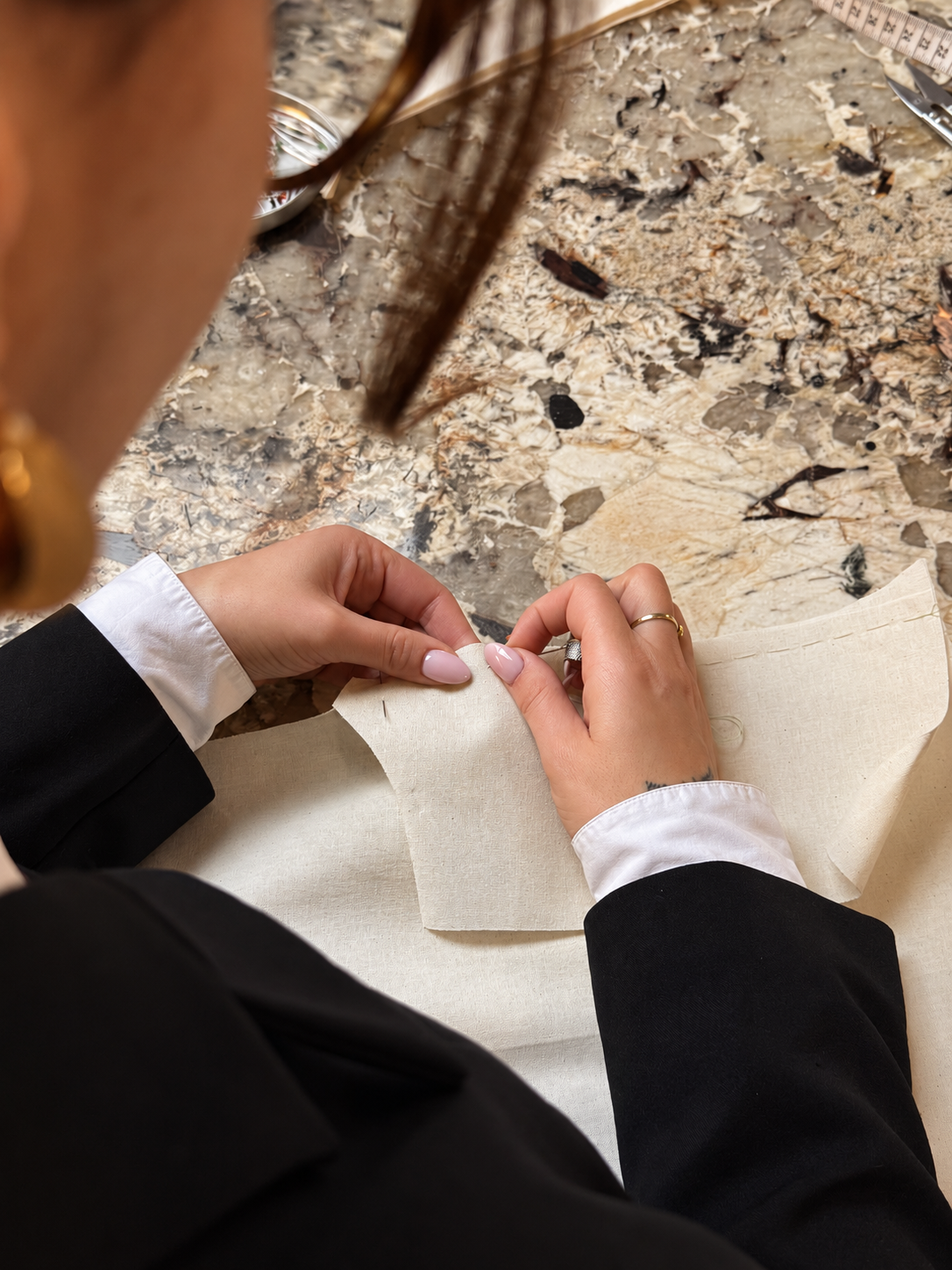
The Savile Row Bespoke Association has published an article on women’s bespoke tailoring featuring several of its member houses. Huntsman states that it applies the same standards of cut, craftsmanship and finishing to its womenswear as to its menswear. In Paris, Sartoria Florio explicitly offers grande mesure for women.
There is no reason, then, to regard men’s bespoke as the definitive standard and women’s as a lesser version. The meaningful distinction lies in the work undertaken for the individual. Pattern, volume and construction must respond to her body, her movements and the garment she has in mind.
This also calls for experience in cutting for women. Expertise in a beautifully made men’s jacket does not remove the need to study the bust, the relationship between torso and hips, or how the client wants her waist to be defined.
How the bust shapes the cut
Bust circumference alone tells only part of the story. Bust height and spacing, fullness, front length and posture all work together. M. Müller & Sohn’s measurement methods record these elements separately. Two women who wear the same clothing size may therefore need different constructions.
Allowing room for the bust is not a matter of widening the jacket evenly. Fullness needs to be placed where it is required, with sufficient length for the cloth to pass over the bust. Adjusting width alone may leave the front out of balance.
Darts help create this shape, turning a flat piece of cloth into a three-dimensional form. They can be moved or incorporated into shaping seams. One M. Müller & Sohn pattern-cutting exercise shows how a bust dart can be transferred into several darts arranged in a fan.
Technique therefore leaves room for design. Accommodating the bust in the cut does not mean it has to be emphasised visually. Depending on the intention, the jacket can follow its contours or sit further away from the body.
Defining the waist by choice
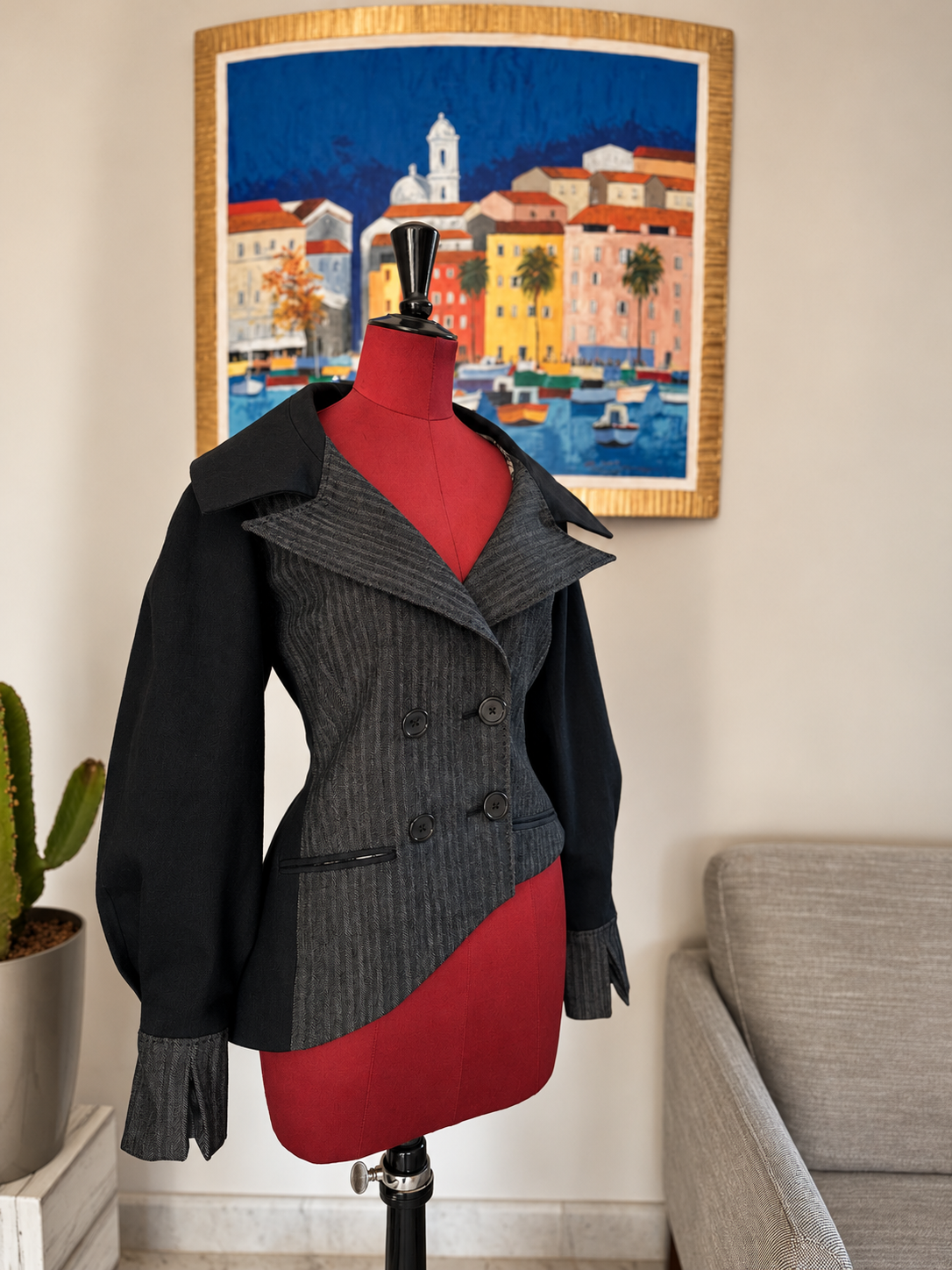
A fuller bust does not necessarily come with wider hips. A slender figure may have a pronounced waist or straighter proportions. These relationships need to be assessed individually. Reducing them to a single image of the female body would lose much of what bespoke tailoring has to offer.
In its jacket adaptations, M. Müller & Sohn distinguishes between ease at the bust, waist and hips, as well as the shaping of the centre back. These areas work together to determine how the jacket hangs, without each needing the same amount of room.
A fitted jacket creates one relationship between bust and waist. A straight-cut jacket creates another. Both can be designed for the same woman. Length also plays a part in the composition, whether the jacket ends near the waist, follows the hips or extends below them.
Waist shaping is a choice of silhouette. On its own, it is not proof that a jacket has been designed for you.
Strong shoulders or a softer line
The idea that women’s jackets must be lighter or less structured overlooks the range of what women want to wear. A defined shoulder may be exactly what one client is looking for. Another may prefer a shoulder that follows her natural line.
Internal construction serves that choice. Mathilde Olivier describes shoulder pads made to suit the wearer’s proportions, alongside canvas work and the shaping of cloth to give the garment its form. Her portfolio also includes women’s jackets. These are tailoring techniques to be used according to the body and the intended effect.
A strong shoulder need not be reserved for men, nor soft construction for women. What matters is the presence it gives the silhouette and how the jacket feels to wear.
The question of trousers
Trousers also reveal the limits of relying on a size label alone. Waist and hip measurements, the distribution of fullness between front and back, the rise and the line of the leg all relate to one another. M. Müller & Sohn’s work on women’s trouser patterns treats these dimensions separately, while preserving the relationships between them.
For the client, this means that a waistband that fastens is not enough to judge the cut. There is also the room allowed through the hips, the way the cloth falls and the comfort of the trousers when seated.
A wide leg can sit beneath a closely shaped jacket. Straight trousers can extend the line of a more generous one. These combinations are part of composing a suit. They need not follow a formula determined by gender or clothing size.
Drawing on menswear
Wide lapels, a double-breasted jacket, pleated trousers, a tie. Each can belong fully in a woman’s wardrobe. Their presence alone tells us little about how the garment has been constructed.
The Musée Yves Saint Laurent Paris explains that the women’s tuxedo introduced in 1966 drew on menswear codes while adapting them to the female body. It illustrates an essential distinction between the inspiration for a silhouette and the pattern that brings it into being.
A client may wish to retain the shoulder width, length or volume she admires in a men’s jacket. The task is to understand those proportions and recreate their effect in her own garment, without automatically taking in the waist or narrowing the lapels.
Kathryn Sargent advocates an approach to bespoke tailoring open to all genders, guided by each client’s needs and personality rather than a prescribed house silhouette. It is a reminder that the craft has a broader vocabulary than the distinction between a man’s jacket and a woman’s.
Our view of women’s tailoring
For Sandra Loï, a woman should be free to choose what her suit expresses. She may want an assertive shoulder, a defined waist, straight lines or volume that moves with her. None of these wishes needs to be justified by her body shape.
We see the body as a starting point for design. A fuller bust need not automatically be concealed. A slender torso does not have to be made to look fuller. Hips can be accentuated or given room. It is for the client to say what she likes; the cut should make that intention possible.
Patchwork brings this thinking into the Maison’s own design language. The meeting of fabrics, their contrasts and the arrangement of panels all contribute to the silhouette. They can draw the eye, extend a line or give rhythm to a surface. Their placement deserves as much attention as the shape of a lapel or the length of a jacket.
We believe precision should leave room for character. A garment can respect the body while making a strong statement. That is what we ask of women’s tailoring: to allow the wearer to recognise herself in a design, with her own proportions and preferences.
Sources
Savile Row Bespoke Association, The Best Women’s Bespoke Tailoring. United Kingdom.
Huntsman, Bespoke Womenswear. United Kingdom.
Sartoria Florio, Femme, Grande mesure. France.
Mathilde Olivier, Votre habit pas à pas et Réalisations. France.
M. Müller & Sohn, Taking Measurements; Blazer with docorative radial Darts; Pattern Adaptations Jacket; Grading Trousers Patterns. Germany.
Kathryn Sargent, True Bespoke. United Kingdom.
Musée Yves Saint Laurent Paris, Le premier smoking. France.
Kyoto Costume Institute, Riding Suit (Amazone), c. 1810. Japan.
Los Angeles County Museum of Art, Woman’s Riding Habit (Bodice, Pants, and Skirt), 1885-1890. United States.
National Museum of Australia, Constance Faithfull’s riding habit. Australia.
Maison Sandra Loï, Le Sur-Mesure.