A few millimetres can change the way a jacket collar meets the nape, a sleeve follows the arm or the front rests against the body. Bespoke tailoring works with these relationships. It begins with a cut developed for one person, then refined through fittings. Presence and comfort take shape together.
For women, this approach opens up possibilities for design. Shoulders can be given more definition, the waist left unrestricted, trousers cut to extend the line of the leg. For Sandra Loï, tailoring draws on these principles and brings them into a distinctive patchwork language. Understanding the work behind them offers a different way of looking at a garment, from its first toile.
Begin with the way you live
A jacket for days filled with meetings and a suit worn to receive an award will not necessarily call for the same cloth, ease or construction. Before measurements comes a conversation. How would you like to wear the piece? What will you wear it with? Which movements should it accommodate?
In its account of commissioned tailoring, Sastrería Serna connects its advice to the occasion, the season and the wearer’s preferences. This relationship between use and design guides the decisions that follow.
Bring a jacket you love, explain what bothers you about another, or show a proportion that appeals to you. Each offers a useful point of reference. A sharply defined line may feel entirely natural to you. A softer cut may give you greater presence. Your experience of clothing helps clarify the intention.
Read the body beyond its measurements
Bust circumference, back length, shoulder width. These dimensions provide a starting point, alongside posture and the way a person carries herself. Two people with similar measurements may have different shoulder slopes or hold their upper bodies differently.
Leonard Logsdail describes how these individual characteristics inform the pattern. Cifonelli also combines measurements with an assessment of posture, shoulder line and movement.
In women’s tailoring, where fullness is placed matters as much as how much is allowed. The bust needs room in a particular place; the back may require ease without widening the entire jacket. Reading the body in this way helps create the intended line for the person who will wear it.
Develop a cut of your own
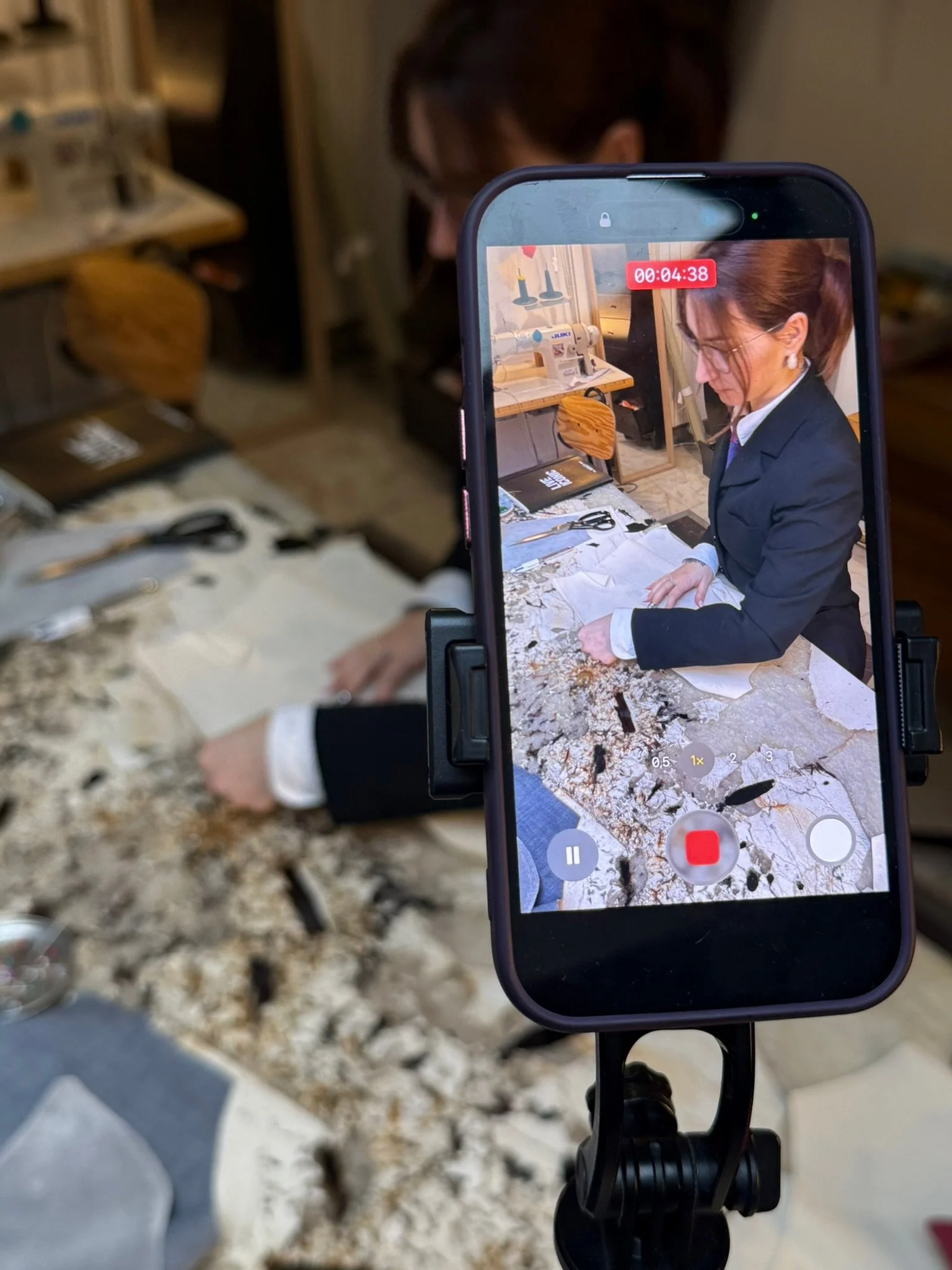
A pattern translates a three-dimensional form into pieces to be assembled. It sets out lengths, curves, darts and the relationships between the fronts, back and sleeves. Under the Savile Row Bespoke Association’s standards, each garment has an individual pattern drafted by hand by a master cutter.
Atelier traditions are not uniform, however. In Naples, Sartoria Pirozzi describes marking the cut directly onto the cloth, without a paper pattern. The shared principle is a cut developed for the individual, with scope to revisit its balance.
That freedom still needs a coherent direction. Lapel width, button position and jacket length work in relation to one another. Choosing them in isolation risks losing the balance of the silhouette. A personal cut emerges from the way they work together.
Choose cloth with the silhouette in mind
A design takes on a different presence according to its material. Suppleness, weight, texture and body affect how a jacket hangs or how trousers move as you walk. Handle the swatch, observe how it folds and consider it in relation to the shape you want to create.
Vitale Barberis Canonico’s catalogue distinguishes between weave, composition, weight, season and intended use. These criteria encourage a closer reading of cloth, beyond its colour or the name of a fibre.
For a patchwork design, the relationship between fabrics also matters. How do their surfaces meet? What role should contrast, continuity and the rhythm of the panels play? Cloth becomes part of the design from the outset.
Shape what remains unseen
Between the outer cloth and the lining, the internal construction helps give a jacket its shape. Canvas supports particular areas and helps form the chest and lapels. Its weight and the way it is worked influence how the garment feels.
Careful construction can remain soft. Anderson & Sheppard describes a very light canvas in its English Drape cut, paired with a lightly padded shoulder. Structure creates shape without requiring the same degree of firmness in every garment.
The iron also has a role in creating volume. At Edward Sexton, a specialist presser helps develop the garment’s three-dimensional form. Depending on the cloth and technique, pressing shapes the fabric as well as refining its surface. Part of a jacket’s character is established before it is finished.
Let the fitting refine the garment
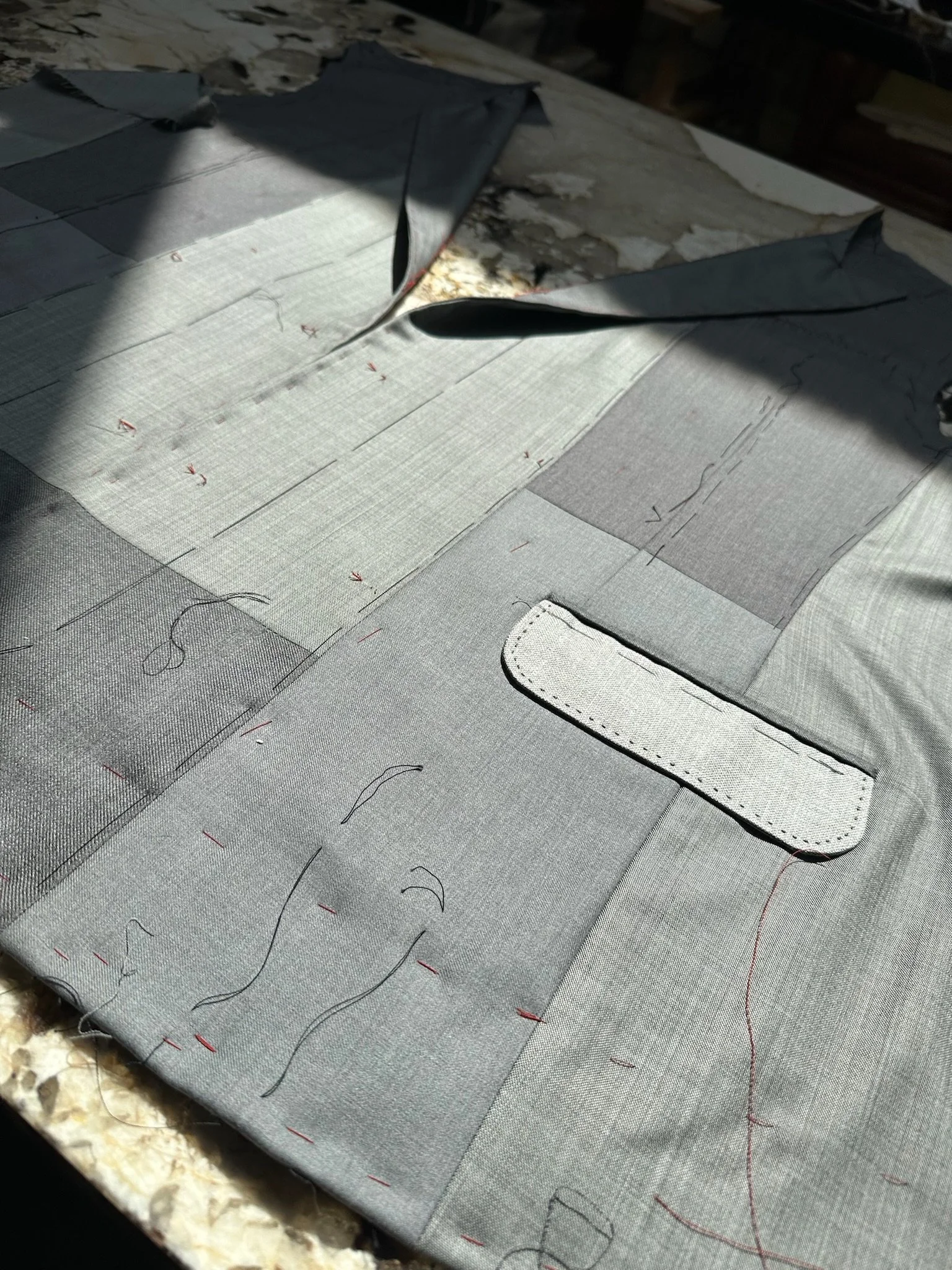
Visible threads, a sleeve temporarily set in place, a seam that can easily be opened. Basting holds the parts together while their relationship is assessed on the body. At this stage, observations need to be translated into adjustments to the cut.
Huntsman’s process offers a clear example. After the first basted fitting, the garment is taken apart and recut to incorporate the adjustments. Its construction, including its balance, remains open to refinement.
A toile and a basted garment are not quite the same thing. A toile is a prototype used to explore the silhouette; a basted garment is temporarily assembled and may already be made in the final cloth. For Sandra Loï, the process includes a toile, followed by fittings that progressively refine the design.
The number of appointments depends on the method and the commission. In Kyoto, Sartoria Cucino includes two fittings before completion in its bespoke service; Serna describes a progression through three fittings. What matters is the work each stage makes possible.
See the silhouette in motion
Walk, sit, reach forward, fasten the jacket. A fitting becomes more useful when it includes the movements the garment will encounter in daily life. A silhouette that looks convincing from the front should also let its wearer move without constantly readjusting her clothes.
Anderson & Sheppard’s account of the English Drape cut shows how a high armhole, fullness in the sleeve head and ease through the chest can work together to free the arm while keeping the jacket in place. It is one approach to cutting among others, to be considered in relation to the commission.
Wear the shoes and undergarments you intend to wear with the finished outfit. Mention any pulling, but also a sense of weight or uncertainty about a length. Your experience complements the atelier’s observations. It helps establish the point at which the cut feels comfortable to live in.
Give each technique a purpose
Handwork allows precise intervention in assembly, internal support and finishing. The Savile Row Bespoke Association’s published criteria include sleeves set by hand, hand-worked buttonholes and canvases shaped for the jacket.
These choices belong to a particular tradition. They do not form a universal checklist to be applied indiscriminately to every design. Sartoria Cucino, for example, explains that its bespoke service combines handwork with certain machine-sewn operations.
To appreciate a piece, look at what the technique achieves. A lapel finds its roll, a lining moves with the wearer, a fastening sits cleanly. Finishing carries the construction through to its final refinement.
Consider the life of the garment
Keeping a record of the cut, explaining care and discussing possible alterations places the garment within an ongoing relationship. Henry Poole describes updating the pattern, archiving the details and advising the client at delivery on how to preserve the garment’s shape.
This attention to longevity also appears in the Austrian Commission for UNESCO’s account of bespoke tailcoat tailoring, added to its national inventory in 2021. It highlights the potential for these garments to be adapted and passed on.
Not every alteration is possible on every piece. What can be changed depends on the cloth, the inlays left in the seams and the construction. Discussing this when commissioning the garment helps you understand how to care for it and how it might evolve.
Our view of bespoke tailoring
For us, being the right size is a starting point. The value of a cut becomes clear in the presence it gives the woman wearing it, in her ease and in how she feels in her clothes. A jacket can fasten perfectly and still feel unresolved. Its length, shoulder line, distribution of fullness or lapel shape may need to be reconsidered.
We believe in design that begins with the individual body. A slender torso, a fuller bust, defined shoulders or fuller hips each invite decisions about proportion. Conversation with the client clarifies what she wishes to emphasise, leave unrestricted or express through her clothes.
This precision must also serve a design intention. For Sandra Loï, patchwork is part of the composition of a suit. Fabrics and panel lines give the piece its character; the toile and fittings allow its proportions to be tested on the body. It is this meeting of cut and design that draws us to the principles of bespoke tailoring.
Our measure of success remains the woman who wears the garment. She should be able to sit, walk, speak with confidence and recognise herself in the silhouette. A successful piece bears the Maison’s signature while leaving room for her personality.
Your commission begins with a meeting with Sandra Loï.
Sources
The methods cited are those described by each atelier or institution.
Savile Row Bespoke Association, Bespoke Process. United Kingdom.
Cifonelli, L’Expérience Bespoke. France.
Leonard Logsdail, Bespoke. United States.
Sartoria Pirozzi, Processing. Italy.
Vitale Barberis Canonico, Fabrics. Italy.
Sastrería Serna, Trajes. Spain.
Anderson & Sheppard, Our House Style, The English Drape Cut. United Kingdom.
Edward Sexton, Savile Row Bespoke. United Kingdom.
Huntsman, Our Bespoke Process. United Kingdom.
Sartoria Cucino, Production Process, Bespoke. Japan.
Henry Poole & Co., Bespoke Process. United Kingdom.
Austrian Commission for UNESCO, Frack-Maßschneiderei. Austria.
Maison Sandra Loï, Le Sur-Mesure.