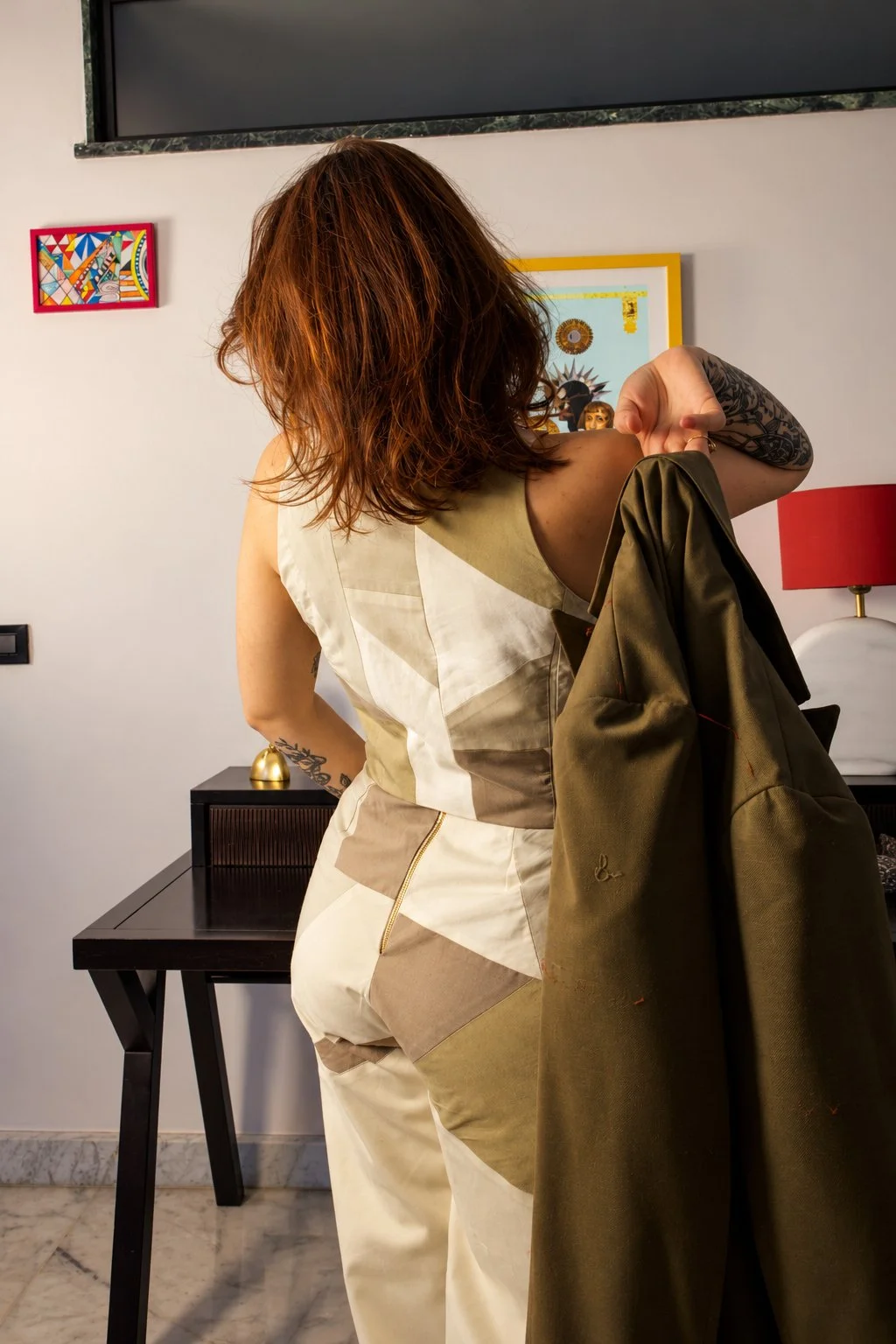
You reach for a glass. Sit down, then stand. The jacket follows; the trousers settle back into place. This continuity is part of the pleasure of wearing a garment. It begins at the fitting, with movements close to those that will fill your day.
A defined silhouette can leave room to move. A loose garment can still restrict. Comfort depends on the relationship between body, cut, cloth and intended movements. At Sandra Loï, the toile and fittings provide a setting in which to examine that relationship.

Begin with your day
A jacket worn at a desk needs to accommodate the arms as they reach forward. A reception calls for handshakes, sitting and long periods standing. A travel outfit also needs to work beneath the coat that will accompany it.
Describing these situations gives the commission direction. It helps determine where to place volume and which areas to observe. The same drawing may require different adjustments according to the way you will wear it.
Fashion history offers an example of this attention to movement. The official Issey Miyake website recalls his work in 1991 for William Forsythe’s ballet The Loss of Small Detail. The dancers’ need for freedom contributed to the development of his pleated clothing. Tailoring uses different means, but movement remains part of the design.
Three positions to explore
Standing, let your arms fall naturally. Observe how the jacket settles without adopting a pose to improve it. Bring your hands forward as if reading a document or holding a steering wheel. Show any tension at the exact moment you feel it.
Seated, notice the hips, waistband and front. Cloth folds as the body changes position; this is normal. Look for pressure, a garment that shifts out of position or the constant need to readjust it.
Finally, walk and come to a stop. Do the trousers or skirt move easily with your stride? Does an opening remain as you intended? Does the jacket return to a position that feels right? These checks add another kind of precision to the view from the front.
Describe the sensation
“The back pulls when I reach forward” is useful information. So is “the waistband presses when I sit”. You do not need to know the name of a seam or suggest a correction yourself.
Discomfort may arise from several aspects of construction. Adding width everywhere is not necessarily the answer. The maker needs to observe the gesture, understand the tension and consider the adjustment within the garment as a whole.
The top beneath the jacket and the intended shoes matter too. They belong to the situation being tested. If you want the piece to serve several purposes, explain them at the outset so that these possibilities can be discussed.
Presence at ease
Freedom of movement need not compromise the silhouette. The shoulder can stay defined, the waist shaped and the trousers clean in their line. The question is how much room the body needs within that construction.
For your project with Sandra Loï, familiar gestures are as valuable as a reference image. They help establish that the chosen silhouette belongs to you when you stop posing. A piece earns its place in a wardrobe when it remains a pleasure to wear for the hours and occasions for which it was conceived.
Sources
Issey Miyake, The Concepts and Work of Issey Miyake, collaboration with William Forsythe in 1991.