
A different kind of suit: reading the language of patchwork
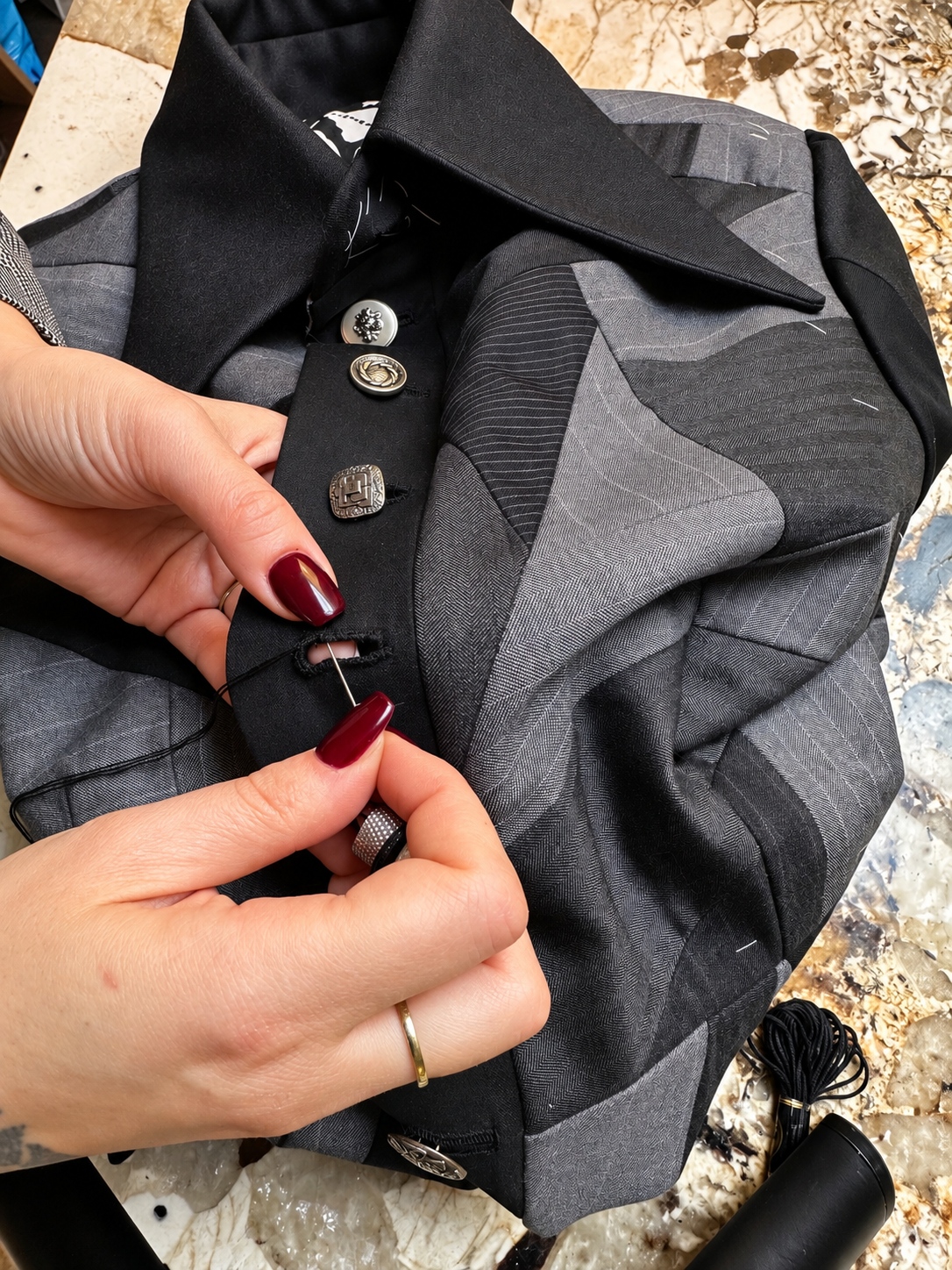
In the atelier, a hand-worked buttonhole continues the patchwork composition, bringing together grey, black and striped fabrics.
A stripe changes direction. Two neighbouring shades meet. A seam becomes part of the composition. Patchwork invites us to see clothing as a relationship between fragments. For tailoring, a particular focus at Sandra Loï, this opens a rich field of possibilities.
In its review of Lafayette 148’s Spring 2027 collection, published on 11 September 2026, Vogue identifies a personal starting point: a quilt made by designer Emily Smith’s grandmother. One expression of that reference is an ivory and white leather ensemble. The example shows that patchwork can work within a restrained palette.
The technique does not dictate an abundance of colour or a bohemian mood. It can organise a surface precisely, introduce a quiet interruption or alter the way we read a familiar garment. Applied to a suit, it raises a specific question: how can the construction of the silhouette converse with the construction of its fabric?
Name the technique before interpreting it
The Victoria and Albert Museum distinguishes patchwork, which joins pieces of fabric, from quilting, which stitches several layers together. The two techniques may be combined, but they describe different operations. A print that imitates joined fragments creates something else again: an image of patchwork.
That distinction helps us look more closely. Does the boundary between two areas correspond to a seam, a change of material or simply a printed line? The answer tells us something about construction. It can also explain why two apparently similar garments behave differently when worn.
In a pieced fabric, the meeting of fragments becomes part of the garment itself. Sometimes it is immediately visible. Elsewhere, it emerges through a stripe, a slight variation in texture or a detail near a pocket. Much of the pleasure may lie in this second, more attentive reading.
Tailoring gives the fragment a framework
A jacket already has its own lines: opening, lapels, pockets, sleeves and shaping seams. Patchwork composes around them. A boundary between fabrics that continues an existing line can strengthen the coherence of the whole. Crossing that line introduces a point of visual tension.
Imagine two grey fabrics, one plain and one striped. Strong contrast brings their meeting into the foreground. Similar tonal values allow the pattern to reveal itself gradually. The choice changes the presence of the garment even when its overall shape remains much the same.
Scale matters too. Large fragments offer a more immediate reading, while smaller pieces multiply the points of contact. Neither approach is inherently preferable. A useful question is whether you want to notice the complete jacket first, or be drawn straight to its surface.
A signature with a life beyond one season
Sandra Loï’s bespoke page describes patchwork construction as a signature of the Maison’s tailoring. The technique therefore belongs to its stated vocabulary. The latest collections provide an opportunity to examine that language more closely, beyond simply noting its appearance on a runway.
For someone considering a garment composed of several fabrics, the task is to find a degree of contrast they will enjoy wearing. Some prefer a narrow palette whose differences appear at close range. Others want clear divisions that remain legible from a distance. These preferences can be expressed through very simple examples.
Three images of clothes you like may reveal a recurring attraction: diagonals, combinations of brown or the rhythm of stripes. Composition becomes easier to discuss in concrete terms. A visual reference can identify a sensibility without asking for an existing design to be reproduced.
Wear patchwork without losing its drawing
One useful starting point is to repeat a colour already present in the garment elsewhere in the outfit. It creates a clear relationship. With a jacket combining several greys, for example, a plain top can allow the nuances to appear without introducing another pattern.
You might then vary texture rather than colour: a smooth surface beside a more pronounced fabric, or a restrained accessory near a complex assembly. These are suggestions to test against the character of the garment. Patchwork does not necessarily require neutral surroundings.
If you enjoy mixing patterns, consider differences in scale. A fine stripe and a larger motif interact differently from two patterns of almost the same size. A photograph of the complete outfit helps assess that balance, extending attention beyond the appealing detail of an individual fabric.
What appearance alone cannot tell us
Patchwork describes a method of assembly. By itself, it tells us neither where the fabrics came from nor whether they were previously used. The V&A notes that some historical examples employed fabrics purchased specifically for the purpose. Calling all patchwork upcycling would lose that distinction.
To understand the material history of a creation, we need information about the particular piece. Its aesthetic qualities are more directly observable: colour relationships, the placement of seams and the rhythm of fragments. There is already a great deal to discover in those decisions.
A patchwork suit makes composition visible. You can appreciate its silhouette at first glance, then discover the relationships running through it. Explore the tailoring on Sandra Loï’s bespoke page and take time to notice where one fabric meets another.
Sources
Vogue : Lafayette 148 Spring 2027, Alexandra Hildreth : 11 September 2026.
V&A : An introduction to quilting and patchwork : updated 3 November 2025.