
When clothing tells a story: from artwork to silhouette
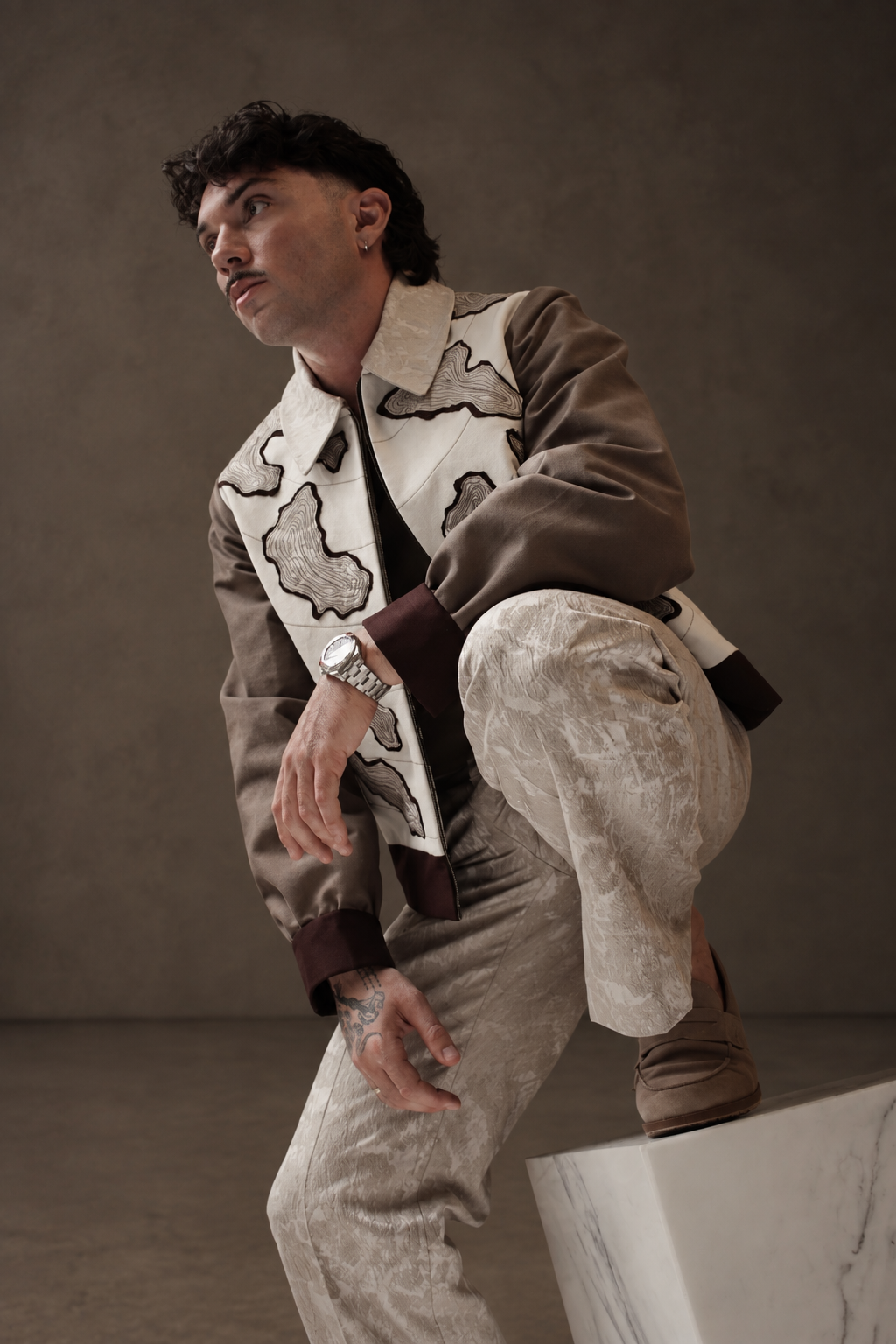
Map-like motifs, contrasting materials and a deliberate stance: the silhouette turns the idea of a journey into clothing.
How does an idea become a cut? “Costume Art”, presented at the Metropolitan Museum of Art in 2026, brings clothing and artworks into dialogue through the dressed body. It invites us to explore another translation: the passage from a story into material, proportion and movement.
A dress can evoke a landscape without depicting it. A jacket can suggest flight without drawing a wing. Between a source of inspiration and a garment lies a whole space of transformation. This is often where creation becomes most compelling: when an idea is felt before it is explained.
At the Met, “Costume Art” pairs garments with works from the museum’s collections. On view in 2026 and scheduled to continue until 10 January 2027, it places the dressed body at the centre of those relationships. Its premise opens a question beyond the museum: how does clothing influence the way we perceive a body?
The body gives an idea its scale
A volume displayed alone may be appealing for its geometry. Once worn, it meets a shoulder height, a walk and a way of holding the arms. The creation takes on a different reading. The space between fabric and body, the length of a panel and the shifting of a fold all contribute to what we see.
Artistic inspiration is therefore more than choosing an image and transferring it onto cloth. It may suggest a proportion, a rhythm or a relationship between solid form and open space. A contrast noticed in a painting might prompt an exploration of a matte surface beside a luminous area.
The result need not make its source immediately recognisable. A silhouette can be enjoyed without knowing its starting point. When a reference informs the construction, it offers several levels of reading: a first impression, followed by the pleasure of understanding particular choices.
A story can give a collection direction
With Le Vestiaire des Immortels, its 2026 couture collection, Sandra Loï brings together twelve mythological figures. Two creations make this translation tangible. Aphrodite combines silk and draping; Ulysse turns toile fabric into textile cartography, with raised islands and stitched lines.
We can read these as two relationships to storytelling. One works through a sense of enveloping the body; the other offers signs for the eye to travel across. This reading does not require the wearer to perform a character. The interest lies in what the reference contributes to the garment.
Turn a reference into a personal intention
A useful starting point for clothing can come from somewhere other than fashion. A travel photograph, a building or an artwork saved for years may all offer possibilities. The next step is to identify the specific attraction: colour, verticality, asymmetry or light.
Consider a photograph of the sea. You might like its blue, its very low horizon or the movement of a wave. Those three reasons lead towards different investigations. Choosing a shade does not create the same garment as exploring how its volumes are distributed.
Putting the attraction into one sentence can help begin a conversation. You may like the way a shape unfolds, want to retain an alternation of dark and light, or seek a line revealed by walking. The image becomes a tool for discussion, carrying an intention that can be explored.
A garment must be able to leave its story behind
A narrative piece eventually meets an actual occasion. Will it be worn to dinner, on stage, at a ceremony or for a portrait? The answer affects what you want to make visible. An idea that works in a close photograph may need a different scale to be read across a room.
There is also a choice about explanation. Some people enjoy telling the story behind a detail. Others simply want to wear it. Both relationships are valid. Clothing may contain a private meaning that has no need to become a public conversation.
This helps prevent a project from becoming overloaded with symbols. Bringing every reference into one outfit can make each intention less legible. Keeping one or two leaves room to develop them and allows the person wearing the garment to remain present within the composition.
Look before interpreting
One simple way to discover a creation is to begin without reading its name. Observe proportions, areas of light and the movement it suggests. Then read its presentation. This second encounter may confirm an impression, shift it or reveal something you had not noticed.
Moving between these two perspectives preserves the freedom of looking. The same line might suggest lightness to one person and authority to another. That difference matters when choosing clothing: a Maison’s proposed story always meets an individual sensibility. A detail can be moving even when it is not the presentation’s central point.
The dialogue between art and clothing becomes practical here. It gives us words to look more attentively, then to choose with greater precision. Inspiration becomes personal when it encounters a way of standing, moving and being seen.
Explore Le Vestiaire des Immortels at your own pace. Let the silhouette make its first impression, then return to the details that explain how it was formed.
Sources
The Metropolitan Museum of Art : Costume Art : on view, scheduled to end 10 January 2027; consulted 4 October 2026.