
A sleeve can give an entire outfit its character. Its volume alters the shoulder’s outline, follows the hands or draws the eye towards the face. In a couture creation, it becomes a field of exploration in its own right.
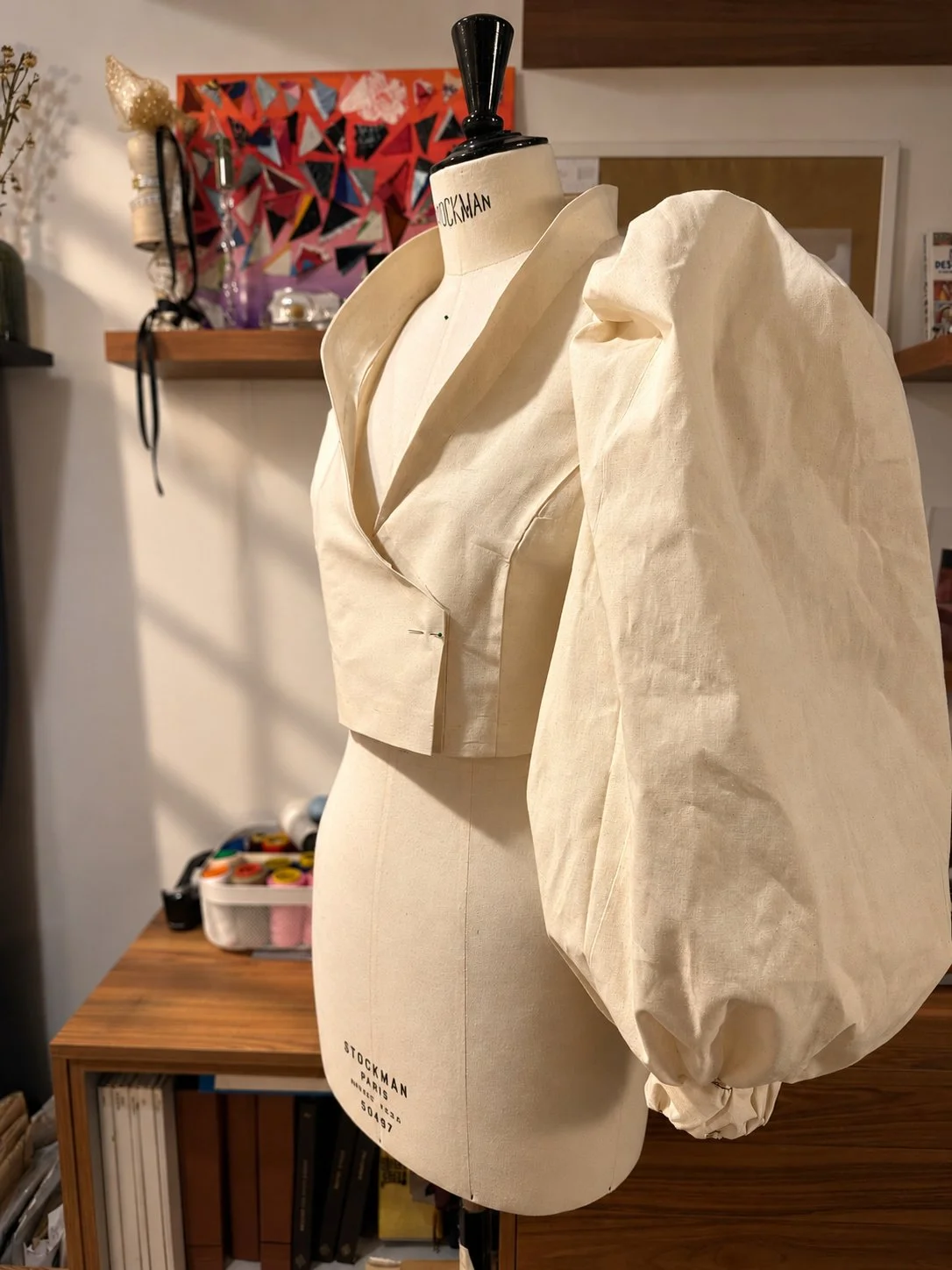
With Gaïa, Sandra Loï gives it a central role. A cropped double-breasted jacket has balloon sleeves. The contrast between a fitted body and volume at either side offers a starting point for a personal silhouette: how much presence should the arm have within the whole?
Where volume begins
Fullness near the shoulder creates a different outline from volume around the elbow or wrist. Before discussing its size, consider its position. This determines the sleeve’s rhythm and its relationship to the body.
Jacket length matters too. A cropped jacket changes how the waist of a skirt or pair of trousers is revealed. A longer jacket creates a different balance between the upper and lower halves. Sleeve volume is therefore chosen alongside the other proportions, then studied from the front, side and back.
One reference can be enough to prepare a commission if you explain what attracts you. Is it the roundness, the height, the opening at the wrist or the space around the arm? Identifying that preference gives the exploration a personal direction.
From drawing to form
Visible volume comes from cut and construction. More fabric alone does not produce a controlled shape. Material, the distribution of fullness and points of support need to be considered together.
In Learning from “The Master”, the V&A describes London College of Fashion students studying Balenciaga creations. Their pattern cutting and reconstructions in toile reveal the complexity of forms that appear simple. A sleeve can be understood as architecture worn on the body.
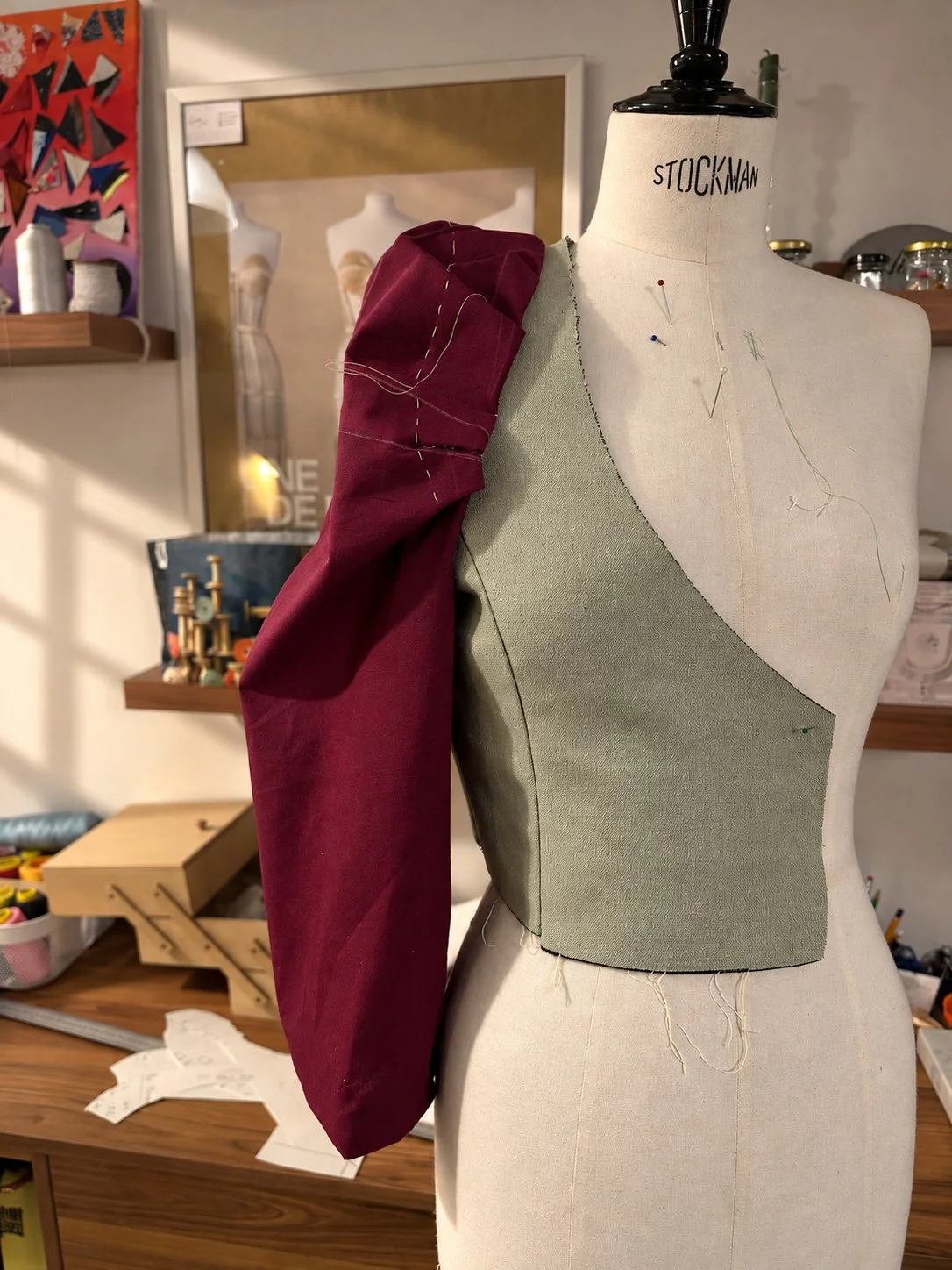
The toile allows an initial proportion to be examined. The final cloth then brings its own weight, surface and response to movement. These stages reveal different aspects of a sculptural piece; the conversation between them develops the form.
A sleeve in motion
A sleeve must work with the arm in motion. Sitting, reaching forward, holding a clutch or greeting someone changes the silhouette. At the fitting, these movements reveal whether the volume remains in place and whether its presence feels right.
Consider the coat that will accompany the outfit. A sculpted sleeve calls for attention to what can cover it without compressing its form. Outerwear belongs to the project, particularly for a winter ceremony or evening.
Finding the balance
A pronounced sleeve can be balanced by a simpler jacket body. It can also work with a full skirt or wide trousers when that is the intended silhouette. Decide what should be read first and how the eye will travel from there.
In Gaïa, the sleeve belongs to a particular composition within the collection. For your own outfit, the idea of sculptural volume can be retained without reproducing the whole creation. A reception, portrait or stage appearance gives that exploration a different scale and purpose.
The sleeve becomes a precise style decision. An outline you recognise, a movement you enjoy, a way of occupying space.
Discover Sandra Loï’s creations.