
Gaïa: the couture suit, from atelier work to silhouette
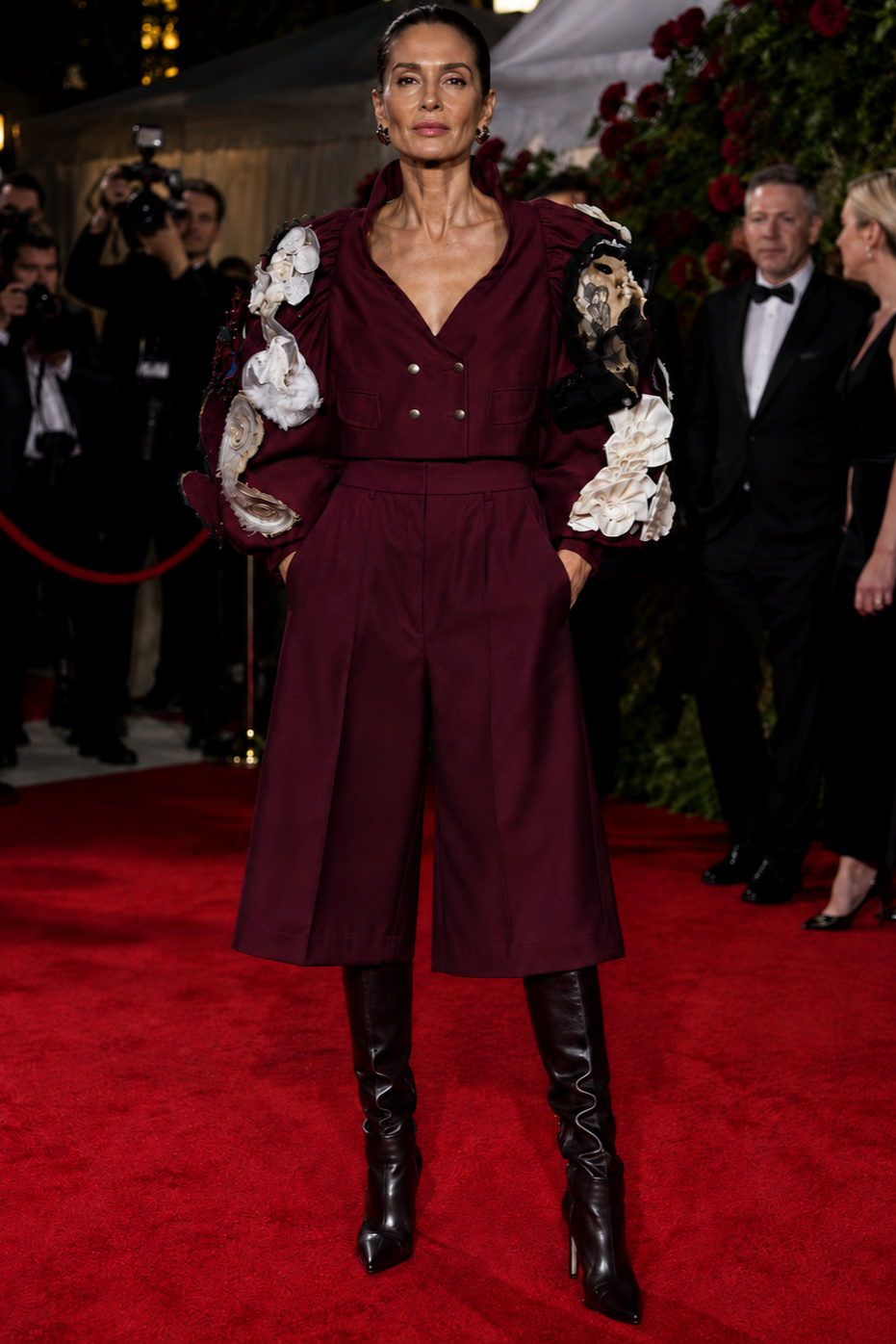
The Gaïa suit is first understood as a silhouette: deep burgundy, a cropped upper half, a double-breasted front and balloon sleeves that relate to the line below. Within this ensemble from Le Vestiaire des Immortels, the jacket concentrates much of the work on volume and ornament. Atelier photographs connect the worn silhouette with its construction details. The 130 hours of creation recorded by the Maison gain a tangible context, without reducing the suit to a number.
Begin with the whole silhouette
Before moving towards the decoration, look at the suit from a distance. The short length of its jacket gives the sleeves a prominent place in the overall composition. The double-breasted front organises the centre, while the volumes at either side broaden the presence of the upper silhouette. These elements work together; isolating a sleeve would overlook the line that supports it.
This observation requires no technical vocabulary. Follow where your eye travels. Where does it settle first? Does it return to the centre, stay at one shoulder or move towards the waist? In Gaïa, the relief attracts attention while the central part of the jacket retains a point of reference. That relationship can be appreciated before every detail has been named.
A photograph on a model provides information that a display on a dress form cannot. The position of the arms and the angle of the torso change how the volumes meet. These are complementary views of a construction that exists in space. No single frontal image can fully describe the way a three-dimensional garment is encountered.
The sleeve becomes a subject in its own right
A sleeve can follow the arm quietly or become the focal point of a suit. Gaïa takes the latter approach. Its balloon volume gives the silhouette a sculptural direction. To the eye, the sleeve is more than a connection between shoulder and wrist: it creates a surface and outline worth examining in their own right.
This choice reveals a broader question in clothing design. Adding volume involves deciding where it begins, where it gathers and how it ends. Fullness close to the shoulder has a different expression from amplitude nearer the wrist. These decisions change the silhouette before colour is considered, which is why volume cannot be understood simply as a greater quantity of fabric.
The dress-form view before the ornaments are added lets us read that volume on its own. Burgundy outlines the balloon sleeve without decoration obscuring its contour, and small fastening elements remain visible. In the decorated view, pale flowers, loops and textile fragments occupy that same shape. Comparing the two photographs helps distinguish the construction of volume from the composition of its surface.
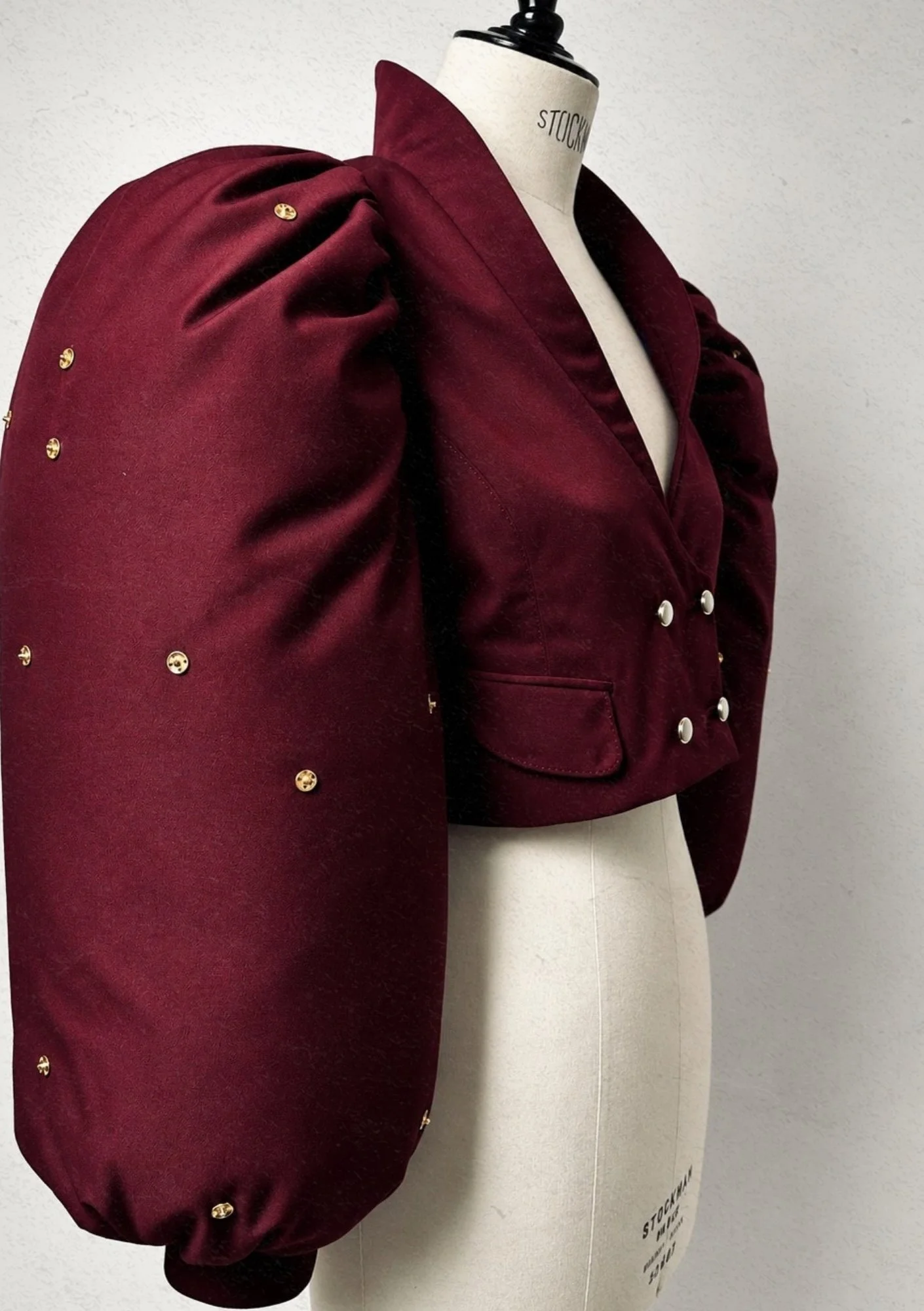
Gaïa before ornament: the balloon sleeve volume and the lines of the front.
From marking to assembly: looking at atelier work
On the worktable, paper templates lie on burgundy fabric, with outlines and thread marks defining the shapes. Another photograph shows hands bringing together a printed textile and a burgundy piece. These images reveal specific gestures and compositional decisions, without claiming to document every operation involved in making the suit.
The front assembled on a dress form still carries basting stitches and pins. The overlap, collar and pockets are already visible, while the sleeves are not yet in place in this view. This stage makes the line that will support the volume easier to understand. The suit can be read at several scales: the ensemble, its construction and each individual detail.
The textile flowers photographed flat reveal layers, buttons and small accents of colour. At the back, ornament occupies the sleeves while the centre remains quieter. Burgundy connects these surfaces and anchors their contrasts. For a personal commission, Gaïa can offer a relationship of proportions, a colour or an approach to decoration, without requiring every element of the suit to be reproduced.
What the figure of 130 hours tells us
The stated duration places Gaïa within a developed creative process. It does not, by itself, specify every operation or the time spent on each. Assigning a number of hours to the pattern, sleeves or finishing would therefore create a breakdown the Maison has not published. The accurate figure remains the one attached to this particular piece.
Nor does it provide a ranking of garments. A creation requiring fewer hours may pursue a different intention and still call for considerable precision. A duration measures time; it does not fully explain the relevance of a design decision. To appreciate Gaïa, we need to return to what is visible: concentrated volume, the relationship with the torso and the presence of the surface.
Connecting time with observation also prevents atelier work from becoming a spectacular number alone. Instead of admiring a figure in isolation, we can learn to recognise the decisions that organise a garment. The same attention can enrich our understanding of a quieter suit, where the work is less immediately apparent to the viewer.
One creation among several distinct propositions
Gaïa belongs to a wardrobe in which fabric is explored in several directions. Hadès develops depth through the pleats of a long skirt; Narcisse works through patchwork; Gaïa concentrates its expression in the sleeves and upper silhouette. Their proximity reveals different approaches, without requiring every piece to create the same effect or tell the same story.
Worn views and atelier photographs complement one another: the former show the suit as an ensemble, while the latter reveal what supports its expression. Explore Gaïa in Le Vestiaire des Immortels, then return to the front, back and ornaments. Its 130 hours take their place within this creation’s story, accompanied by forms and gestures that can actually be observed.
Explore Le Vestiaire des Immortels.