Creating a bespoke suit: understanding the time involved
How many hours does a bespoke suit take to make? The question seems to call for a number, yet two ensembles can involve very different work. The cut of the trousers or skirt, the jacket’s construction, patchwork and ornament all belong to the same project. To understand the time behind a suit, it helps to follow the decisions that develop the whole silhouette rather than look for one duration that applies to every commission.
Working hours and delivery time are different measures
Working hours refer to time spent on the project. The delivery period runs from the order to the handover. Between interventions there may be appointments, material arrangements, decisions awaiting confirmation or the ordinary scheduling of the atelier. Converting a number of hours into consecutive days therefore does not establish when a garment will be ready.
For a fixed occasion, communicate the date when the piece must be available, including any travel beforehand. An outfit for an event abroad needs to be ready before departure. Explaining that constraint at the first meeting allows a real schedule to be discussed, with room for fittings, instead of relying on an abstract estimate of sewing time.
Nor is the number of appointments a universal unit of quality. It depends on the project and the adjustments it requires. The useful question is what each stage will allow you to approve and when particular decisions need to be settled. The schedule then becomes a way to work together, rather than simply a wait for the finished garment.
Designing the suit as an ensemble
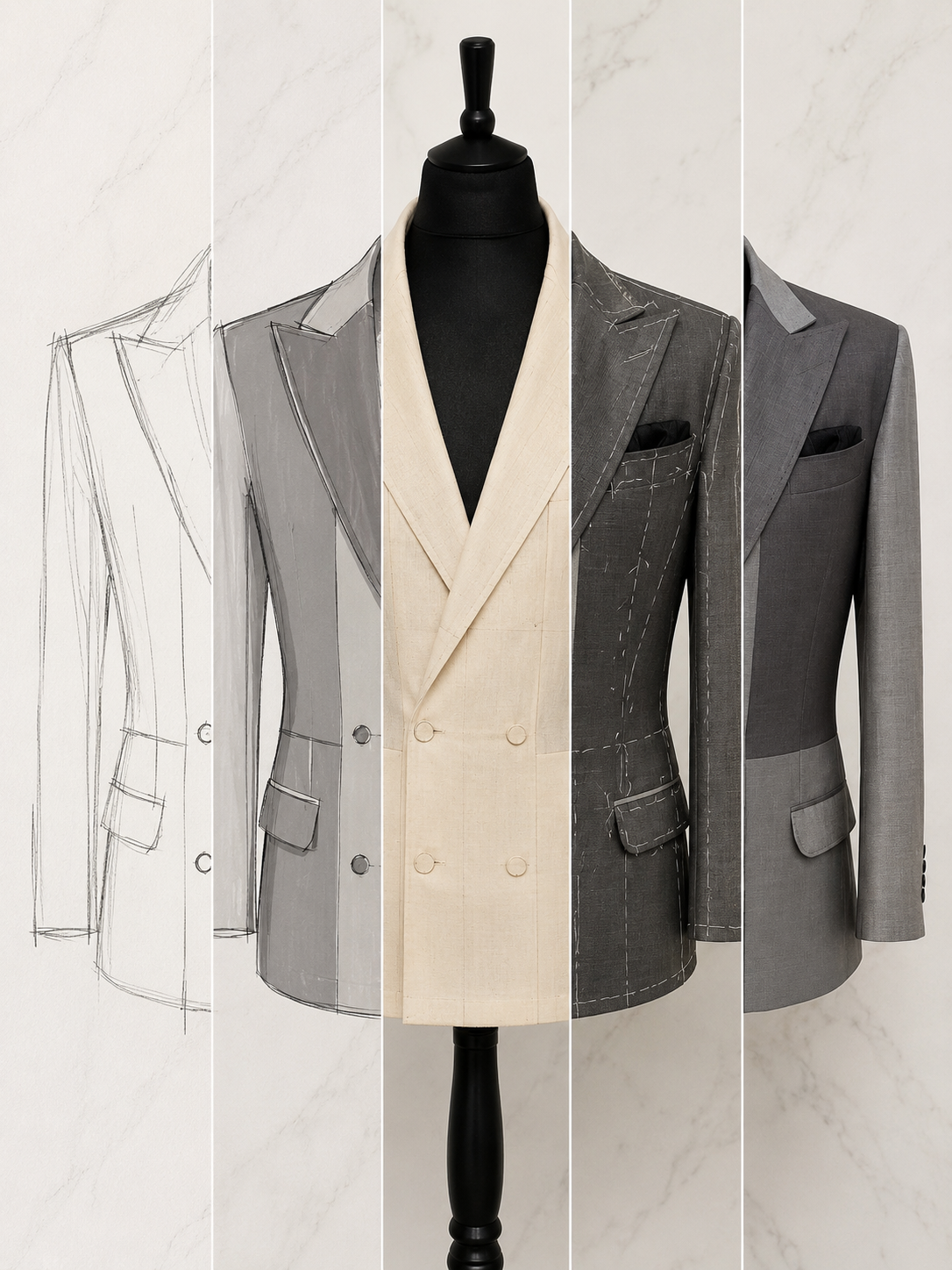
Before cutting, an intention must become a construction. The length of the upper half, a pronounced shoulder, the waist position and the fullness of the lower half need to work together and suit the intended use. This involves decisions that may barely register in the finished image: space when seated, room for a layer underneath or the relationship with a skirt or trousers.
A drawing helps organise those choices, but cannot resolve all of them. An appealing line on paper must still become a volume around the body. Pattern cutting translates the intention into pieces that can be assembled. An apparently small alteration, such as moving a seam, may affect several parts of the design. Time is not determined simply by the area of cloth involved.
For the client, describing references precisely helps at this stage. Explaining that you like a sleeve for its amplitude or a suit for its proportions identifies what matters. A late request for a different overall balance may require more than a local adjustment. It is better to express uncertainty early than let it become a disagreement about the final piece.
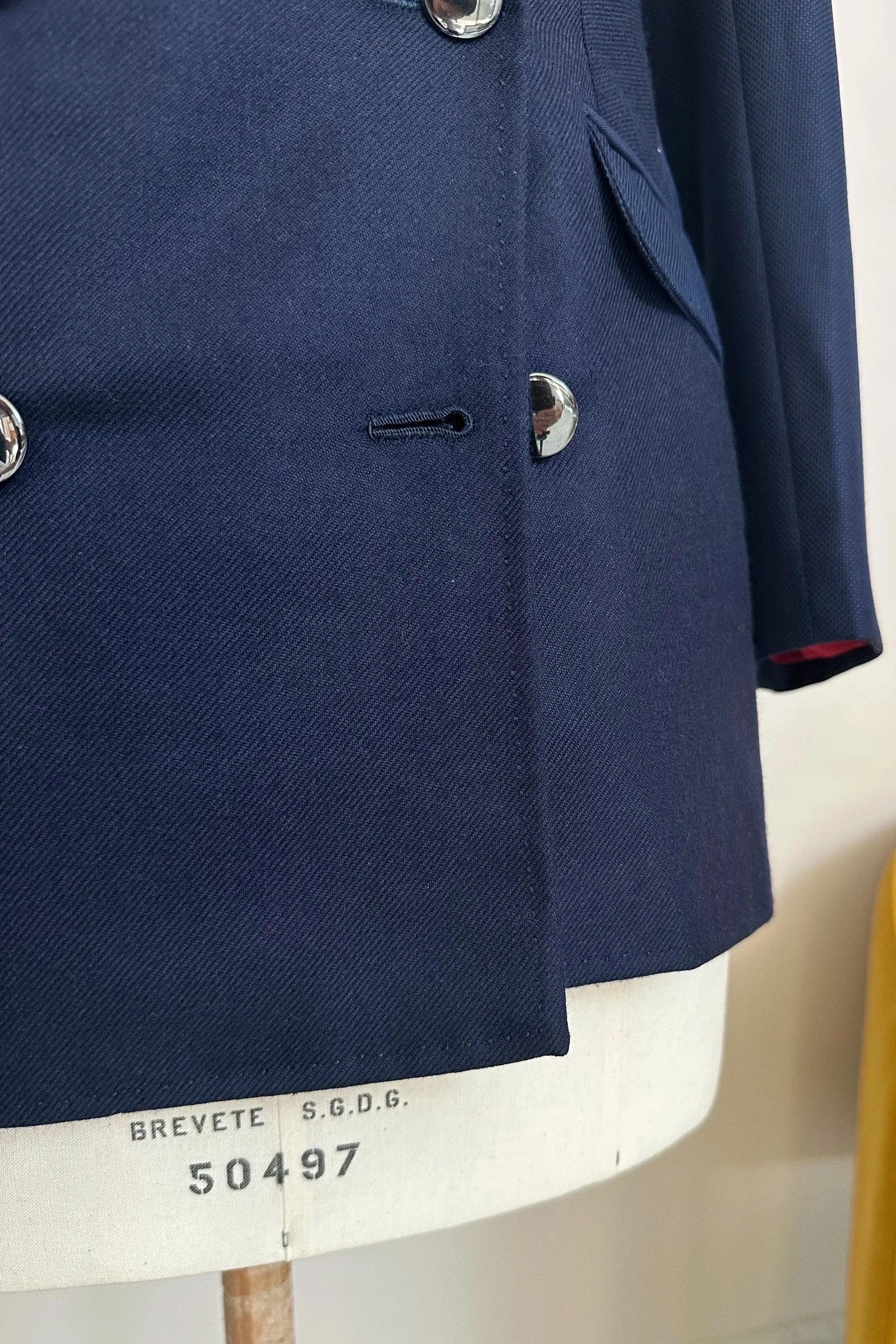
A jacket on a dress form offers one view of its construction.
The toile allows decisions before the final fabric
In Sandra Loï’s published process, a toile fitting helps develop the silhouette. This prototype makes it possible to examine proportions on the wearer. It should not be judged as a completed garment: its finish, colour and material behaviour are not yet those of the final piece. Attention is directed primarily towards shape and the space available for movement.
The appointment makes possibilities tangible. A length can be marked, a volume observed and an opening discussed. The project becomes easier to read than it was in a sketch alone. To make the most of it, talk about sensations as well as appearance: freedom through the arm, pressure at a fastening or how the suit settles after a gesture.
A toile reduces some uncertainties without removing the need for later fittings. The final fabric has its own weight and flexibility and needs to be observed in turn. This transition from prototype to chosen cloth explains why a commission cannot be reduced to taking measurements once and then executing a drawing without further conversation.
Complexity may be visible or discreet
Textile decoration attracts attention immediately, while a well-positioned collar or balanced sleeve can seem self-evident. Those quieter elements nevertheless require care. Assembly, adjustments and finishing all affect how the suit sits on the body. A restrained appearance is therefore not enough to infer that a piece required little work.
Patchwork brings another question: the fragments need to form a readable composition once assembled and worn. Joins, contrasts and the position of each section are part of the design. Preparing them may be as significant as sewing them. Sandra Loï’s patchwork signature invites that kind of observation, beyond simply counting how many fabrics appear in the garment.
Gaïa provides one documented reference. The Maison states 130 hours of creation for this cropped, double-breasted jacket with balloon sleeves. That figure belongs to Gaïa. It is neither an average for a complete Sandra Loï suit nor a published allocation of hours between pattern cutting, assembly and decoration. It describes a particular project and cannot serve as a promise for another.
Ask about the scope of your own commission
A useful conversation concerns the scope: does the quote cover a complete suit, with trousers or a skirt, or just one piece? Discuss its fabric, details and stages of approval. Ask how a change of direction would be handled after a decision has been confirmed. These points help explain a quote and schedule without turning craftsmanship into a competition over the highest number of hours.
Time becomes meaningful when it serves a result defined with you. To prepare a bespoke suit, explore the Maison’s bespoke process and share your occasion, constraints and references. An estimate can then relate to a real creation, with specific choices and a clear purpose, rather than to the general idea of a tailored ensemble.
Explore bespoke creation at Sandra Loï.