
The price of bespoke: understanding what a quote includes
Comparing a bespoke suit commission with a garment in a shop means looking at what is actually being offered. Fabric matters, alongside design, fittings, details and the scope of the service. There is no automatic price hierarchy covering every category. A quote becomes useful when it is connected to a defined project and makes clear what will be included in bringing that project to life.
Compare projects rather than labels alone
Ready-to-wear and bespoke describe different ways of offering clothing, but neither determines a price by itself. An elaborate ready-to-wear piece can cost more than a simpler personalised commission. A logo, production scale or number of fittings cannot provide a complete comparison. The garment’s characteristics and the accompanying service need to be considered together.
In series production, some design work can be shared across several garments. An individual commission involves decisions specific to the project, such as proportions, adjustments, fabric combinations or particular details. That difference helps explain part of the cost, but it does not justify a fixed percentage that could apply to every house or every type of clothing.
The first question is therefore the starting point. Will an existing model be adapted, a silhouette developed or a piece created with specific details? Offers described broadly as custom clothing may answer differently. To compare them, you need to understand what will be decided with you and what already belongs to the selected model or service.
Material and construction are separate considerations
The cost of a fabric does not describe the entire finished garment. Working with it may require particular precautions, pattern matching or trials. A motif to position, transparency to address or several fabrics to combine introduces questions that the quantity of material alone cannot explain. Cloth needs to be considered in relation to the proposed cut and intended result.
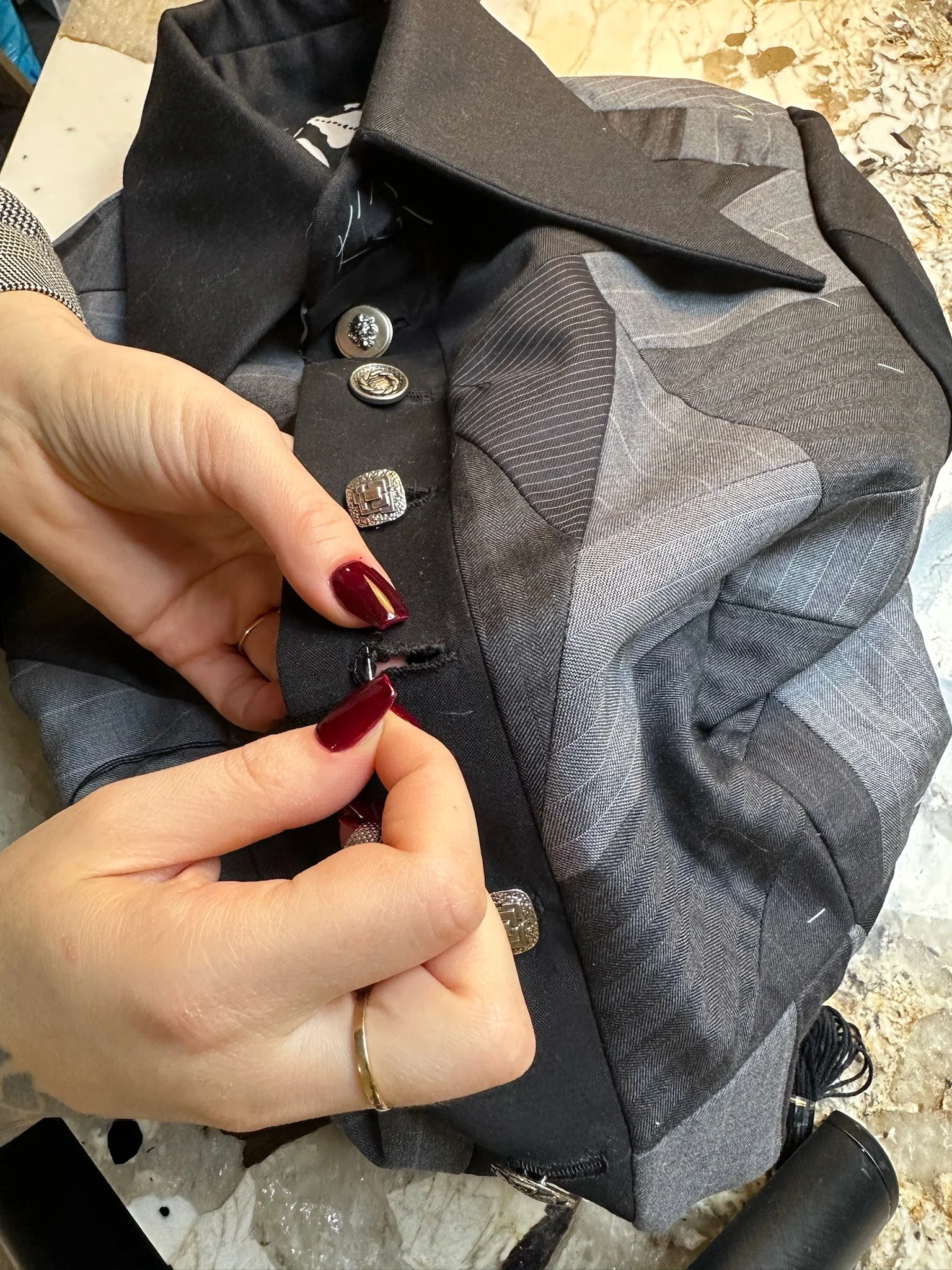
Patchwork is a useful example. Fragments must be selected and arranged into a composition. Their placement affects the finished image as well as the assembly. Sandra Loï identifies this construction as a signature of its tailoring. In a commission, the conversation can concern the extent of that work and the prominence you want it to have within the silhouette.
Finishes and details also deserve to be named. Lining, pockets, fastenings and applied decoration all form part of the project. You do not need specialist knowledge to discuss them: ask what the quote includes and what would change with another option. A concrete answer provides more understanding than a sequence of flattering descriptions of craftsmanship.
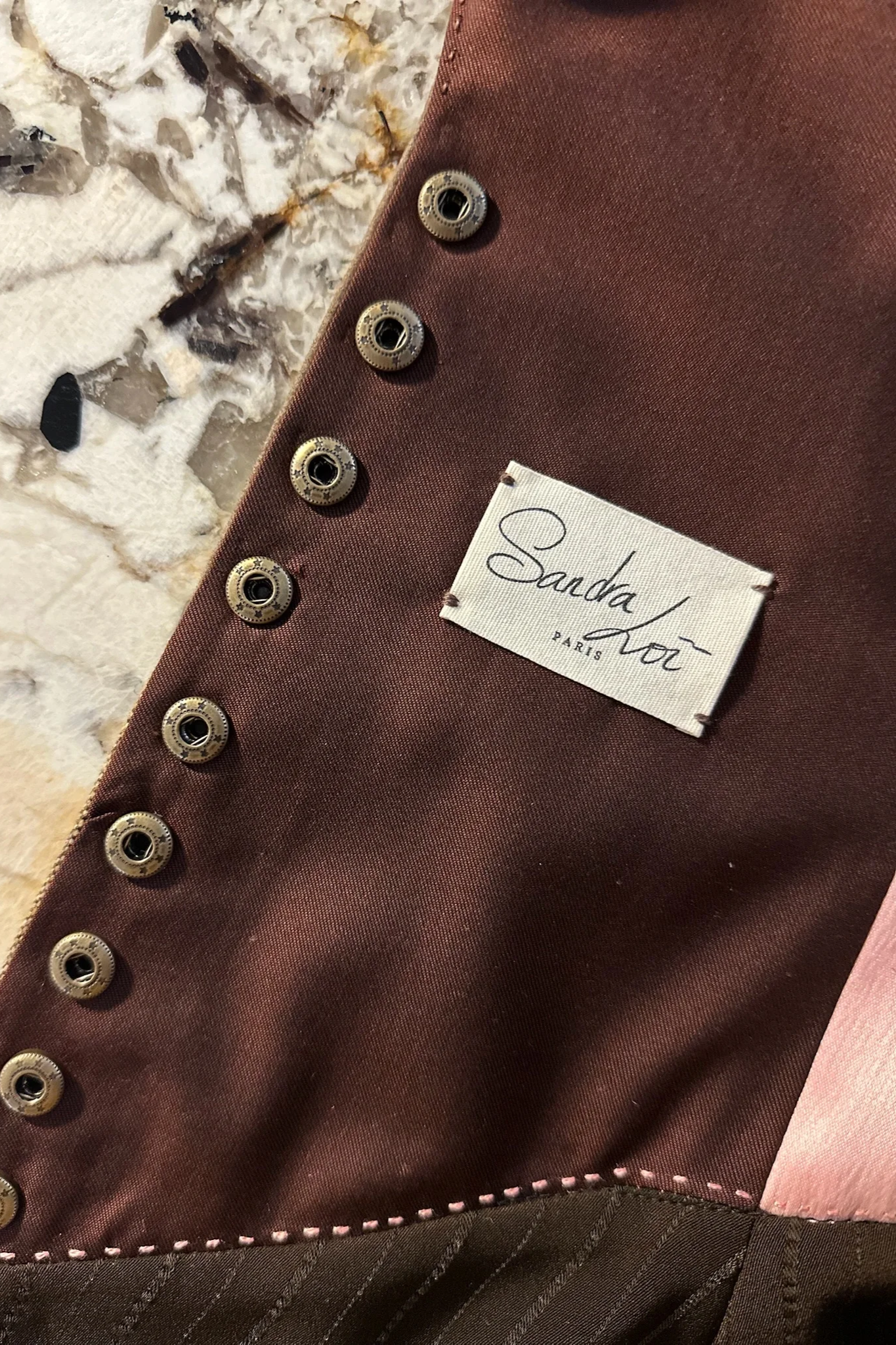
Details belong to the project: their choice is considered alongside the garment’s construction.
Fittings serve a defined purpose
A fitting is more than an appointment to view progress. It allows the garment to be observed, sensations to be shared and adjustments to be considered. In Sandra Loï’s described process, a toile and subsequent fittings accompany the development of the silhouette. That time belongs to the creative work even when no sewing is taking place in front of the client.
Ask which stages are included and how they connect. In particular, distinguish an adjustment needed to achieve the agreed design from a new stylistic direction requested during the process. A different length or volume can have different implications depending on how far construction has progressed. The terms should be discussed in relation to the actual commission.
Availability affects the organisation too. Travel or a tight schedule may limit possible appointments. Explaining this early allows the feasibility of the service to be assessed. Price and timing become meaningfully comparable only when both sides understand the constraints, rather than when the quote is considered separately from the client’s calendar.
Understand the boundaries as well as the service
A useful quote should identify the garment, the selected options and the corresponding amount. Before committing, clarify payment arrangements, the expected schedule and how possible changes would be handled. For choices still open, ask when and how they will be confirmed. These are questions of clarity that support a good working relationship with the atelier.
Care and later alterations deserve a separate conversation. The possibility of modifying a piece depends on its construction, material and the requested change. It should not be assumed to be unlimited or automatically included in the original price. Ask about concrete possibilities while the project is being defined, especially if future adaptation is an important reason for your choice.
Longevity cannot be guaranteed by the word bespoke alone. Wear, care and changing preferences also matter. You can choose a garment with the intention of using it for years without turning that intention into an environmental claim or a guaranteed financial return. The most tangible criterion remains how well the piece answers the need for which it is being commissioned.
Define priorities before making the decision
Setting a budget does not reduce a project to its price. It helps explain where you want to concentrate the work: a particular cut, decoration, fabric or a complete outfit. If several options are available, their effect on the silhouette and quote can be discussed openly. This makes choices easier to assess without treating every detail as equally essential.
For a Sandra Loï commission, share your occasion, references and constraints in the first conversation. The Maison’s bespoke page describes the stages of its service and provides a starting point for requesting an appropriate proposal. Its value can then be considered through the specific garment and work it includes, rather than through the label alone.
Explore bespoke creation at Sandra Loï.