A bespoke suit: what makes a silhouette feel coherent
Sometimes we notice a suit before identifying its cloth or details. The proportions of its upper and lower halves, their fabric and the way the ensemble is worn seem to share one intention. That coherence does not come from a universal formula. It develops through connected decisions, then finds its test on the wearer, in her movements and in everyday life.
Begin with a specific intention
“I would like a beautiful suit” opens a conversation, but does not yet give a commission its direction. An outfit for a full day with clients answers different needs from an ensemble for a ceremony. One may need to move easily between standing and sitting; the other may give priority to a particular volume, opening or detail that the wearer wants to emphasise.
It helps to name two or three priorities instead of collecting a long list of adjectives. Do you want to keep the jacket closed? Wear a layer underneath? Use the trousers separately? These questions lead to practical decisions. They also prevent a collection of individually appealing ideas from becoming an outfit that no longer reflects how you actually dress.
A reference photograph can help if you explain what attracts you. It might be the jacket’s length rather than its shoulders, the colour rather than the fabric, or the simplicity of the combination rather than its fit. Breaking down an image allows a personal project to develop without asking your body to reproduce somebody else’s silhouette.
Proportions work in relation to one another
A jacket’s length cannot be considered entirely on its own. It meets the trouser waist, the width of the leg and the volume of any layer underneath. Changing one element alters the reading of the others. A cropped jacket may give a wide leg more visual space; a longer jacket may create a different continuity. Neither is a universal formula for lengthening or slimming every figure.
At a fitting, look at the whole before concentrating on a detail. Examining only a sleeve or waist can obscure the original intention. The front view should be joined by a look at the profile and back, followed by a few steps. A photograph may help compare options, but it cannot replace the experience of wearing the garment.
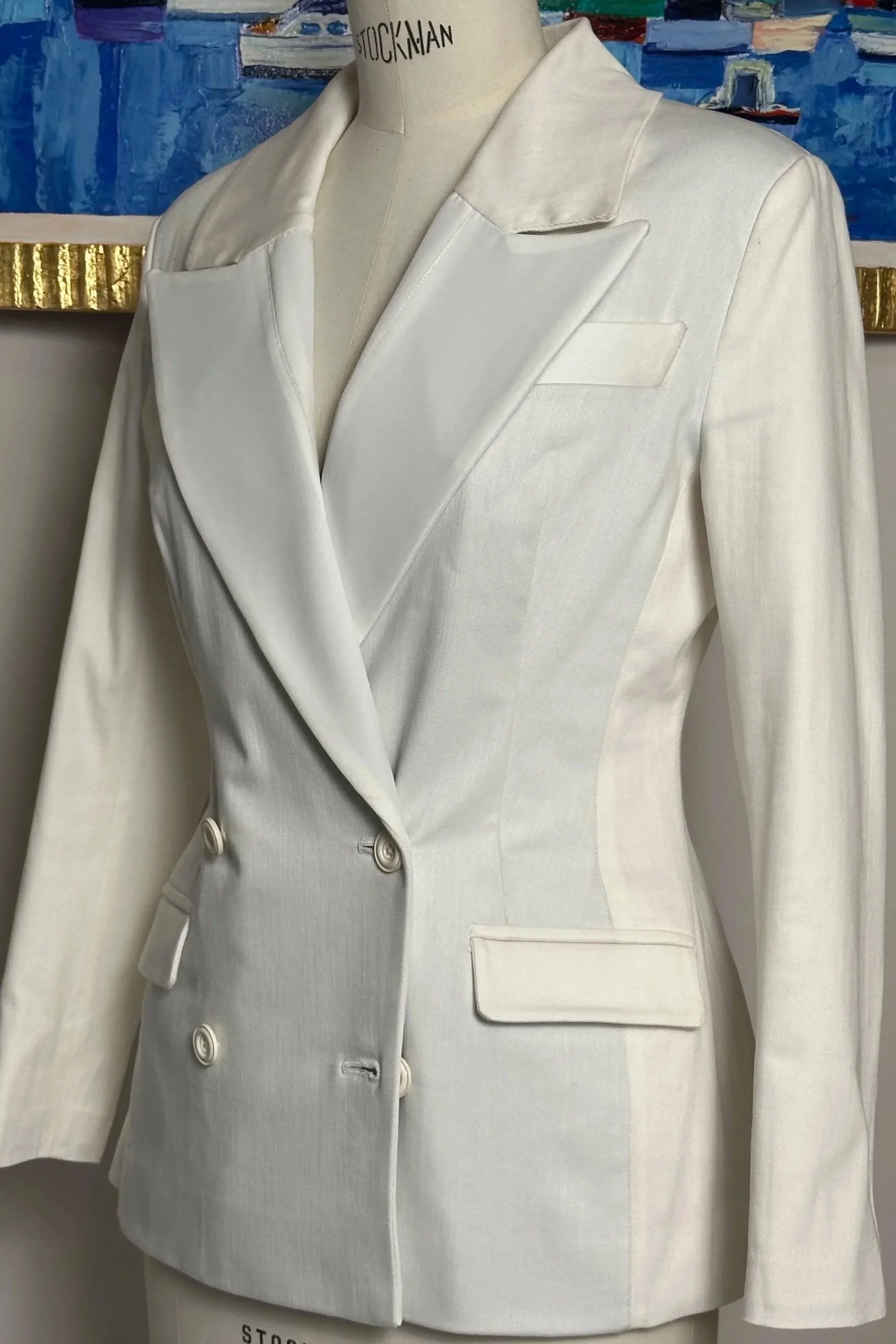
Within Sandra Loï’s collection, the contrast between the Gaïa suit, with its cropped upper half, and other, longer lines shows how the distribution of volume changes an ensemble’s expression. A collection piece need not become a direct template for a commission. It can provide a starting point for discussing length, amplitude and where the eye should settle.
Cloth changes the drawing
A line on paper does not yet have the weight of fabric. A supple cloth, a textured surface and a firmer material will form different folds. Before deciding, consider how a sample bends, catches the light and relates to the other parts of the project. Colour alone cannot predict the finished effect, particularly when several materials will meet in one garment.
Patchwork makes this relationship especially visible. It brings several surfaces into a piece, inviting the eye to follow their boundaries, contrasts and joins. Sandra Loï presents patchwork as a signature of its tailoring. For a personal project, the question becomes how prominent that composition should be, and what possibilities the Maison can offer within the intended silhouette.
Details often become easier to choose once the main line is established. Distinctive buttons, a contrasting lapel or a visible pocket can redirect attention. Considering them together helps decide what should lead and what can support it. Coherence does not require a plain garment; it requires choices that make sense when seen as a whole.
A fitting tests a way of living
A suit that looks right in a mirror still needs to accommodate its intended movements. Sit down, bring your arms forward as if working at a table, pick up your bag and stand again. The aim is not to make tailoring behave like sportswear. It is to check that the construction suits the ordinary movements for which you are choosing it.
Specific feedback is more useful than a general verdict. “I feel tension when I reach forward” identifies a situation to examine. “I need to pull the trousers up after sitting” describes something observable. The person making the garment can then consider fit, construction or volume without requiring you to diagnose the technical cause yourself.
Bring the shoes and type of underwear you intend to wear when they are relevant to the fitting. They may change how the outfit settles. If you want to use more than one heel height, explain that early: a single trouser length will not necessarily produce the same effect with every pair. That difference is easier to discuss before the final hem is chosen.
A silhouette that belongs in your wardrobe
Coherence also needs to be tested against what you already own. A suit intended for regular use should work with your tops, accessories and habits. An ensemble reserved for an event can accept more specific choices. Both projects are valid; they are simply assessed against different uses rather than the same idea of versatility.
Sandra Loï’s published bespoke process, from the first conversation through the fittings, provides a framework for connecting these decisions. To prepare for a meeting, choose an occasion, a few annotated references and your priorities for comfort. The silhouette can then develop around a clear need, with enough freedom to become recognisably yours.
Explore bespoke creation at Sandra Loï.