
The history of the women’s suit: more than one route to freedom
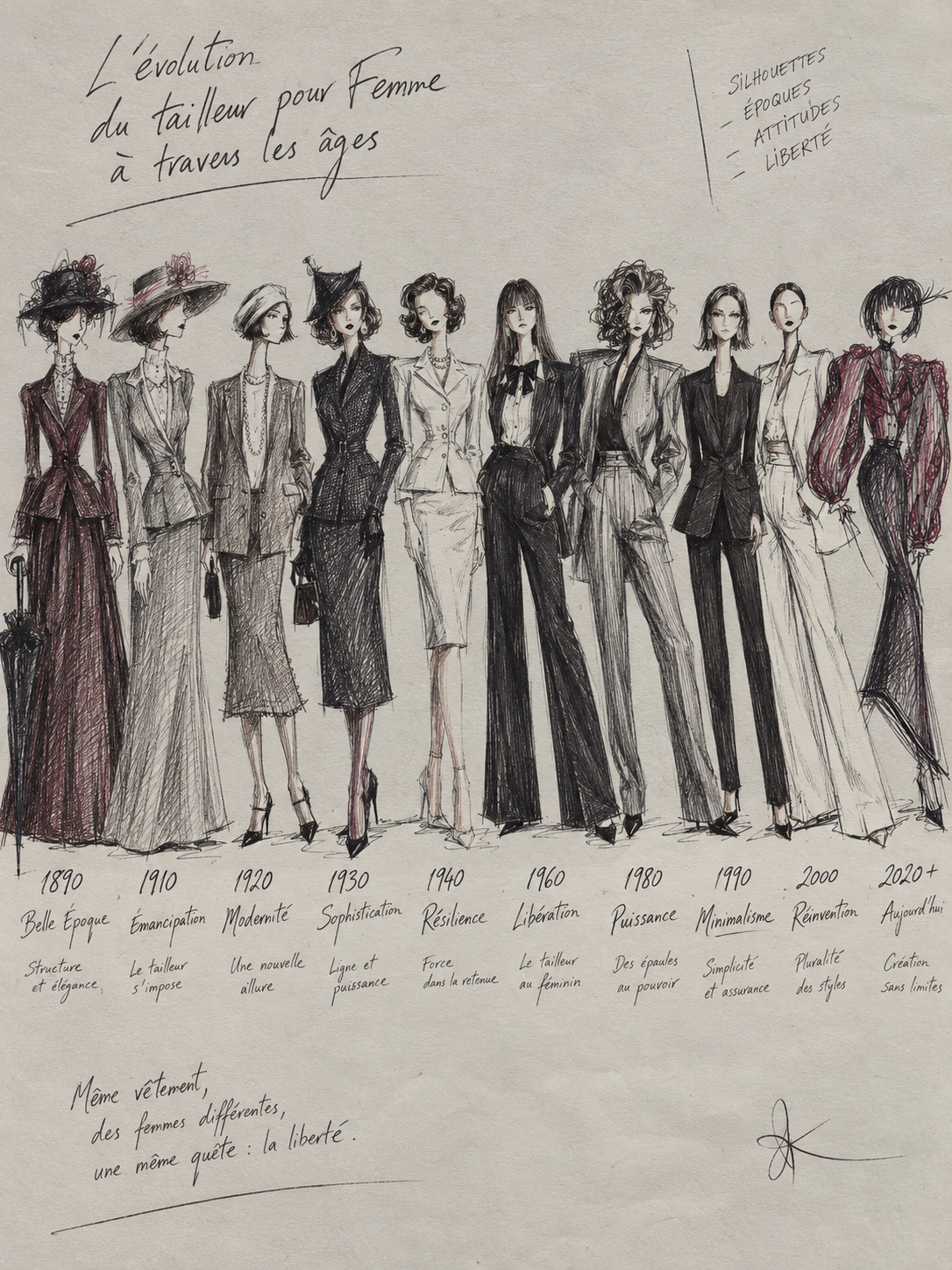
Skirt suit, trouser suit, tuxedo: the women’s suit brings together silhouettes whose histories are not interchangeable. To understand the ensemble, we need to consider what it allows its wearer to do as well as how it looks. A few carefully chosen moments reveal its ability to change meaning while retaining a recognisable structure.
A history that begins before the trouser suit
Today, the word suit often brings a jacket and trousers to mind. That association can obscure the history of the skirt suit. The Victoria and Albert Museum holds an example from the 1890s whose jacket draws on tailoring while retaining the fashionable volumes of its period. A new approach could emerge within existing conventions, without overturning all of them at once.
This distinction helps avoid a familiar shortcut: describing the women’s suit as a garment that was universally forbidden and then suddenly permitted. Skirts and trousers did not follow the same path, either in their uses or in the responses they attracted. Fashion history becomes clearer when we name the actual garments. A fitted jacket, a walking ensemble and an evening tuxedo answer different needs, even when they share elements of construction.
Looking at historical clothing also requires some distance from our own expectations. A silhouette that seems highly structured today might have offered practical advantages in its original context. Equally, a style we now associate with freedom was not necessarily available to everyone. Museum objects document particular garments; they cannot stand for an identical experience shared by all women.
Chanel and the relationship between cloth and movement
Gabrielle Chanel offers a useful way to examine that relationship. The V&A records her use of jersey in the 1910s and the importance of tweed suits, introduced in her collections in the 1920s and central after her return in 1954. These dates point towards a change in how tailoring could be worn, rather than the invention of the women’s suit itself.
They also suggest a question that remains valuable at a fitting: what gives the garment its shape? Is it the cloth, the cut, the internal construction or the way it rests on the shoulders? Two suits in a similar colour can feel very different. Comfort is therefore part of the design from the beginning, rather than an extra added to an attractive silhouette.
This perspective takes us beyond calling a suit simply classic. A familiar line may contain careful work on ease and movement. Conversely, a visually striking garment may be unsuitable for the intended use if its volumes feel restrictive. Visual novelty and freedom of movement are separate questions that deserve to be considered together.
1966: the tuxedo finds a different wearer
Yves Saint Laurent introduced his first women’s tuxedo in the autumn/winter 1966 collection. The Paris museum explains that he adapted masculine codes rather than reproducing them unchanged. The couture version initially attracted few buyers; the rive gauche version subsequently reached a younger clientele. The reception of an idea could change with the way it was offered.
The significance lies in a new arrangement of evening dress. A jacket and trousers offered another possibility for an occasion strongly associated with gowns. The tuxedo redirected attention towards graphic lines, the opening of a jacket and contrasts between surfaces. It offered a language for dressing without prescribing the personality of the woman who chose it.
Her reasons could be equally varied. She might enjoy its sensuality, restraint, comfort or departure from familiar expectations. A garment’s cultural history and an individual’s reasons for wearing it can meet without becoming the same story. Keeping that distinction makes the history richer and the present-day choice more personal.
Reading that inheritance in a contemporary silhouette
These moments encourage us to notice decisions within an ensemble: the relationship between jacket and skirt or trousers, the placement of buttons, the opening of a collar and the length of sleeves. Tailoring is recognisable through an arrangement of lines, but that arrangement allows considerable variation. A cropped jacket and a long skirt distribute volume differently from a longer jacket and a narrow trouser leg.
Hadès offers a particular interpretation at Sandra Loï. In Le Vestiaire des Immortels, a structured jacket meets a long grey skirt with pleats formed by hand. The combination can be read as a conversation between a defined upper silhouette and a more mobile surface below. This observation does not claim a documented historical influence; it shows how older questions can sharpen our reading of a contemporary creation.
The important point is to avoid turning inheritance into a rule. A jacket does not have to express authority, a skirt softness or trousers rebellion. Those readings belong to a viewer and a context. Personal choice becomes more interesting when several interpretations remain available at the same time.
Continuing the story through use
Before choosing a suit, begin with a real situation: walking across a city, speaking in public, getting married, dining or travelling. That situation helps identify which familiar codes you want to keep and which you would like to move. Buttons become a question of opening and closure; length becomes a question of proportion and movement.
The history of the women’s suit does not lead to one ideal silhouette. It offers a repertoire to interpret. Explore Le Vestiaire des Immortels to continue that reading: the contrasts between its volumes provide several answers to an enduring question, how to construct a garment that its wearer can make her own.
Explore Le Vestiaire des Immortels.
Sources
Victoria and Albert Museum : Skirt suit : object dated 1890 to 1899.
Victoria and Albert Museum : What makes CHANEL so iconic? : 17 April 2024.
Musée Yves Saint Laurent Paris : Le premier smoking : autumn/winter 1966 collection.