
Made-to-measure and bespoke: the method behind the words
Made-to-measure, bespoke, sur-mesure and grande mesure are sometimes used as if they were interchangeable. Yet they can point towards different methods and different degrees of individual development. When commissioning a suit, the useful questions concern its starting point, the role of fittings and the decisions genuinely open to you. Precise language should clarify the offer rather than take the place of an explanation.
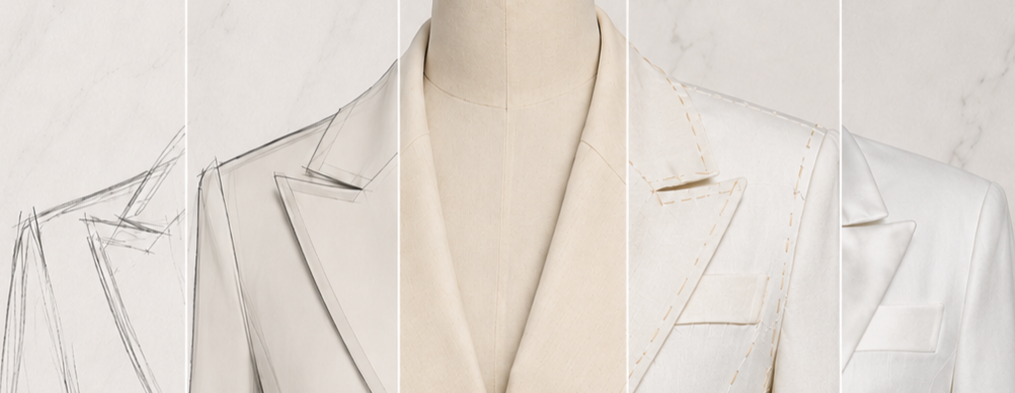
First, understand what will be changed
An alteration works on an existing garment. It may adjust a length, reshape an area or address certain fitting issues within the limits of the original construction. The result depends partly on available material and elements already fixed in place. Alteration work can be highly demanding without becoming the initial design and making of a new piece.
A commission adapted from an existing base follows another approach. The model and some principles of construction are established, then measurements or options allow it to be personalised. This may suit a client who particularly likes the proposed silhouette. The important point is to understand which proportions can change and which characteristics will remain those of the original model.
A project involving an individual pattern and fittings to refine its form has a different relationship with its starting point. The silhouette can be considered more specifically for the wearer. That does not imply the absence of a house style, established techniques or references. A personal creation can still belong to a recognisable visual language and draw on accumulated expertise.
What grande mesure invites us to examine
In tailoring usage, the French term grande mesure refers to individual cutting and successive adjustments. Rather than treating the term as a sufficient guarantee, ask how that approach will operate in the proposed commission. Pattern development, a prototype and fittings offer more concrete topics for discussion than a broad promise of exclusivity or a claim of absolute perfection.
The English-speaking tailoring tradition provides a complementary reference. For its own standards, the Savile Row Bespoke Association describes an individually handmade pattern and work supervised by a master cutter. This explains a particular tradition. It should not be presented as certification of Sandra Loï or as a definition imposed on every house using the word bespoke.
Translation therefore needs care. Made-to-measure generally refers to adapting an established base, while bespoke suggests more individual development. In French, sur-mesure can function as a broader expression. Comparing these words alone, without examining the stated method, risks creating quick equivalences between services that may actually differ in their scope and execution.
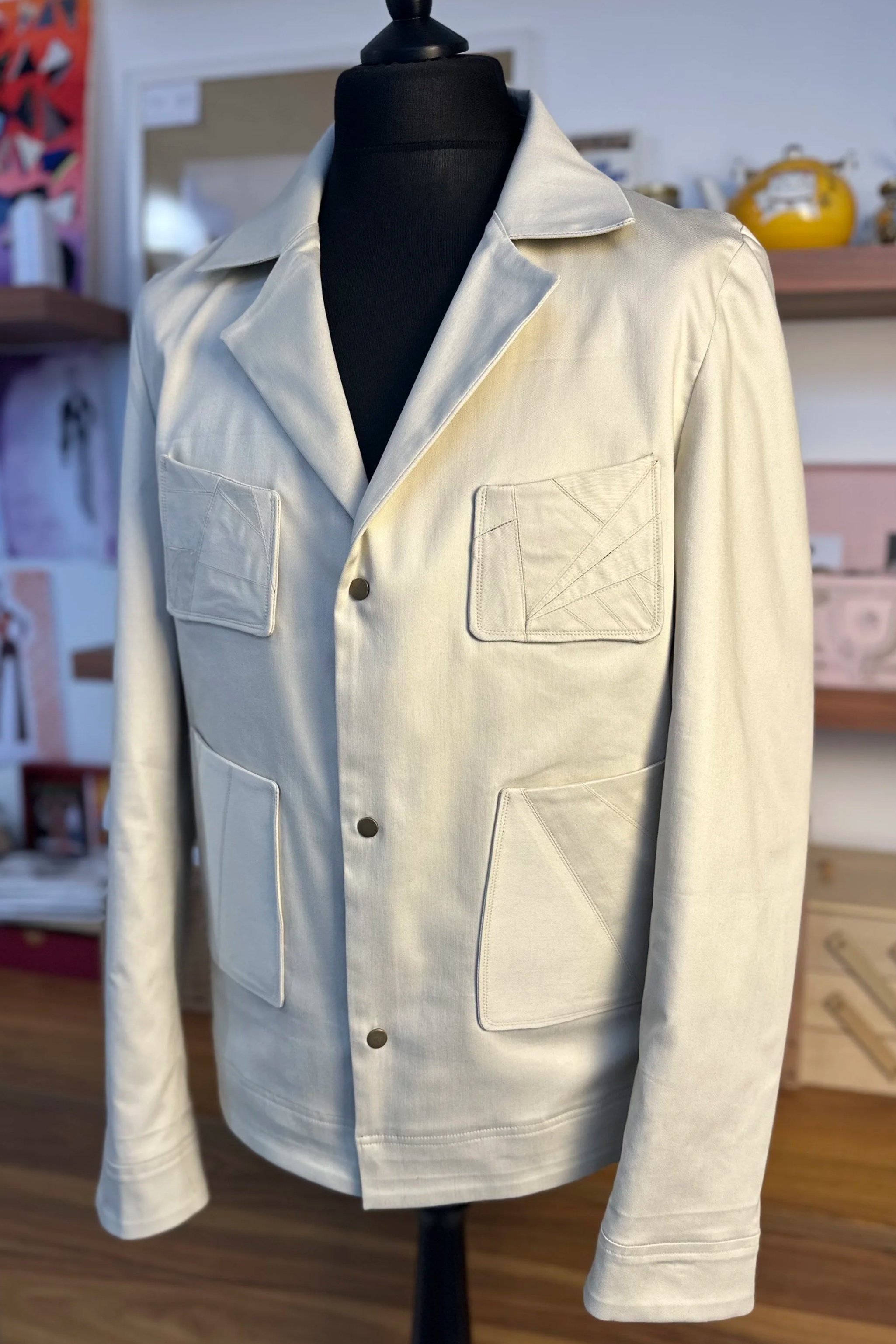
A garment can also be read through its cut lines and the relationship between its parts.
The toile shows more than dimensions alone
A measurement record describes dimensions. It cannot by itself communicate the weight of a jacket, the experience of a volume or the ease of a gesture. A toile gives the project an initial physical presence. Length, openings and proportions can be discussed by observing them on the wearer rather than imagining them only from a drawing or numerical record.
This means looking at a garment still in development. The colour and behaviour of the trial fabric may differ from the final result, so it is important to understand what is being approved. The prototype helps refine form; fittings in the final cloth will allow other aspects of drape and construction to be examined in turn.
A toile is therefore meaningful information, but deserves an explanation. When does it appear in the process? Which decisions does it support? How are the observations carried into the next stage? These questions reveal what the prototype does within a particular project, instead of making it an abstract symbol of quality detached from the work itself.
Fittings are more than a number
A stated number of appointments does not tell the whole story of what happens during them. One fitting may address overall volume, another the behaviour of the material or a specific area. For the client, the important question is how observations will be considered and which stages will allow the result to be checked before completion.
The exchange itself is part of the process. Reporting discomfort, uncertainty about length or a difference from the original intention gives the work an observable direction. Bespoke does not require you to speak like a technician. It requires room to describe what you feel and to understand the possibilities offered in response to those observations.
It also helps to distinguish an adjustment to the agreed project from a new design request. Completely changing a sleeve after approval is different from refining its placement. Such situations need to be discussed within the commission, including any effect on the schedule and quote. Understanding that distinction makes the collaboration clearer rather than less creative.
The approach described by Sandra Loï
The Maison describes its tailoring as inspired by the principles of grande mesure. Its public process includes a meeting, design and sketch, a toile, fittings and the handover of the creation. That wording allows us to discuss the stated method without adding specific techniques, a fixed number of appointments or a certification that has not been established for each project.
When choosing a service, begin with straightforward questions: what base will the garment start from, what can you decide and how will its fit be assessed? Explore Sandra Loï’s bespoke stages, then share your expectations. The terminology becomes most useful when it describes the concrete work planned for your own garment, rather than standing alone as a promise.
Explore bespoke creation at Sandra Loï.